For this post, I want to reflect upon no-fee public libraries, inspired by Medium’s article “The Fine Free Library: One Year Later.” The article featured several anecdotes from patrons who had strayed from utilizing the library for fear of being charged late fees and had subsequently returned once the fees were eradicated. This is so important for library professionals to consider in structuring late policies in their own institutions. After reading Medium’s article, I found the ALA’s page on “Fines and Overdues” that explains that late fees became popularized after a 1989 article from The Bottom Line: A Financial Magazine for Libraries argued that overdue books both inconvenience other patrons and place financial burdens on the library, which may need to replace the book as a result (ALA, n.d.). One excellent, ideological counterargument to that point was made by Library Service Director, Nancy Martinez, who states that “library users amass such huge fines that- instead of paying the fines-they simply forfeit their library privileges. We want our books back, and even more we want our borrowers back” (ALA, n.d.). However, I was also interested in looking at the numbers for this argument and found an EXCELLENT report from Library Journal called “Fine Farewells: LJ’s 2022 Fines and Fees Survey” that provides a comparison of public libraries’ institutional fines from 2017 to 2022. Take a look at the graph below that highlights several areas of fines that changed over the years:
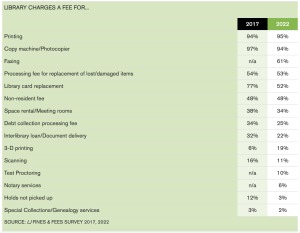
(I realized after the fact that WordPress cannot publish the graph without shrinking it; however the full size can be found within the references below)
Amazingly, they found that between 2017 and 2022, the number of libraries that charge fines for late books dropped from 96% to 36%!
Ultimately, the funds collected from late fees contribute a fractional amount when compared to a library’s overall annual budget, and Library Journal argued that the amount further lowers drastically when considering how much time it takes paid staff to collect and process them (Library Journal, 2022). I currently work in a predominantly no-fee library, and the only books that we charge late fees for are our selection of new books, which get re-cataloged into our regular collection after a few months. I think that this is a great compromise that ensures the library remains an equitable space, yet also considers patrons waiting to read the newest, popular titles that amass large hold queues.
References
American Library Association. (n.d.). Fines and overdues. https://www.ala.org/tools/atoz/fines-and-overdues
The City Library. (2018, August 10). The fine-free library: One year later. Medium. https://slcpl.medium.com/the-fine-free-library-one-year-later-d28c69743c15
Gerber, A. (2022, September 28). Fine farewells: LJ’s 2022 fines and fees survey. Library Journal. https://www.libraryjournal.com/story/Fine-Farewells-LJs-2022-Fines-and-Fees-Survey