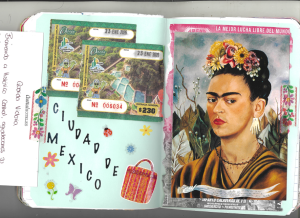
Scan of my personal junk journal of a spread I created after a trip to Mexico City.
Junk journaling has emerged as a creative practice that blends art, memory keeping, and sustainable reuse, inviting people to transform everyday materials into deeply personal works of expression. Rather than relying on traditional scrapbooking supplies, junk journaling encourages the use of “found” or repurposed items like ticket stubs, envelopes, packaging, old book pages, fabric scraps, and other ephemera that might otherwise be discarded. This approach lowers the barrier to entry for new creators and aligns with broader movements toward mindful crafting and environmental responsibility. Many practitioners describe junk journaling as both grounding and imaginative: a space where storytelling, collage, and tactile exploration come together.
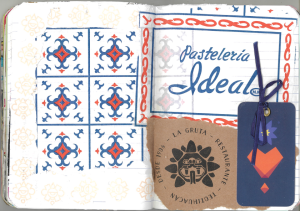
Another spread from my personal journal that shows reuse of tags, placements, and a bread bag from a bakery in Mexico City.
The Monthly Junk Journaling Workshop at the library builds on this ethos by offering teens (16+) and adults a welcoming, low pressure environment to explore creativity with accessible materials. Participants will learn simple techniques for assembling journals, experiment with mixed-media layouts, and discover how everyday objects can become meaningful artistic elements. By centering sustainability, self-expression, and community connection, the workshop reflects the library’s commitment to fostering lifelong learning through hands-on participatory experiences.
Mission and Institutional Context
Mission Statement: LA County Library belongs to our communities and serves as a portal to learn, grow, and succeed.
The Monthly Junk Journaling Workshop is grounded in the values and strategic priorities outlined in the LA County Library 2024-2028 Strategic Plan, which positions the library as a trusted, community centered institution committed to fostering learning, creativity, and connection. The plan emphasizes four core values: trust, hope, leadership, and connection; each of which aligns naturally with the participatory, creative, and relationship building nature of junk journaling. By offering a hands-on, low barrier art program, the workshop supports the library’s mission to provide equitable access to enriching experiences that help patrons “learn, grow, and succeed.”
The Strategic Plan also highlights the importance of welcoming spaces, inclusive programming, and opportunities for personal development. Junk journaling directly contributes to these goals by creating a supportive environment where teens and adults can explore self-expression, develop new skills, and engage with others across generations. Additionally, the workshop’s emphasis on creative reuse reflects the library’s commitment to sustainability and responsible stewardship of resources. Through this program, the library continues its role as a community hub that nurtures creativity, strengthens social bonds, and empowers patrons through meaningful, hands-on learning.
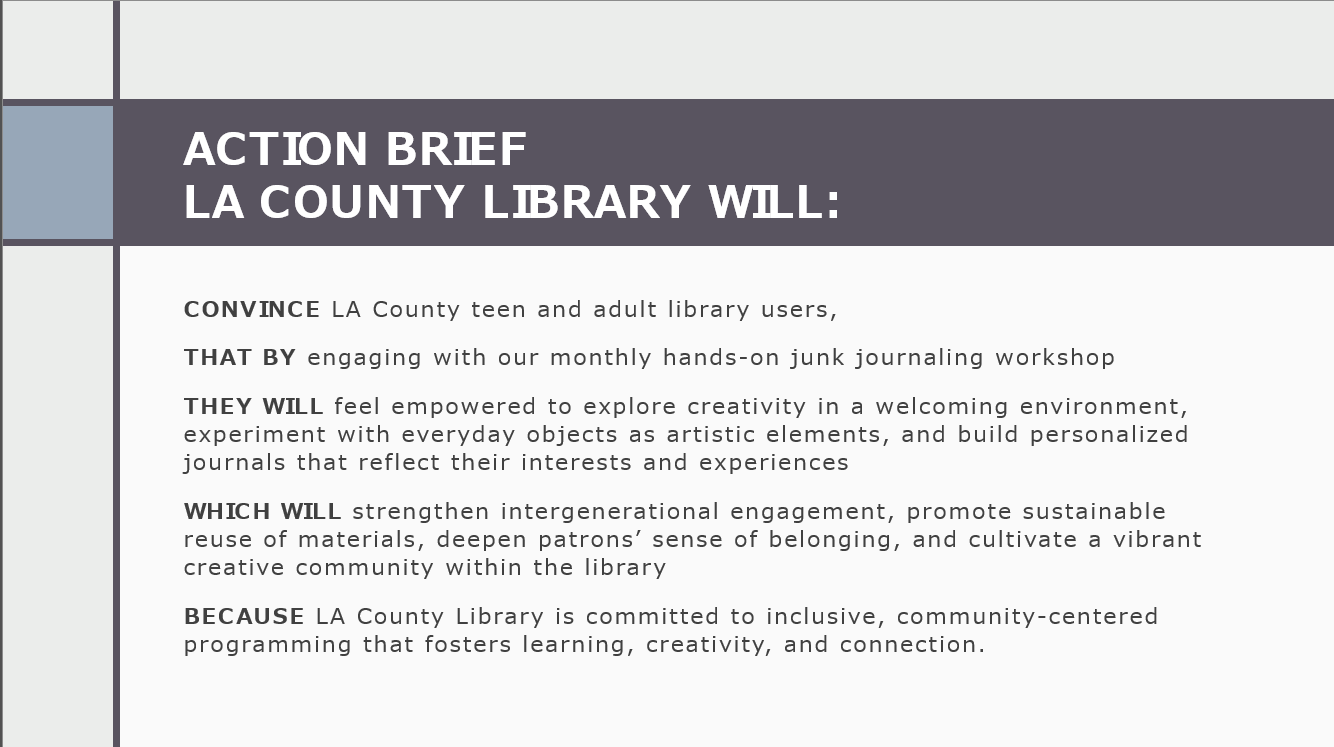
Action Brief
Inspiration
- The Downey Public Library’s Junk Journaling Workshop event page: https://www.downeylibrary.org/calendar-of-events/junk-journaling
- Los Angeles Public Library’s Crafternoon: Junk Journals event page: https://www.lapl.org/ko/event/10190
- Whittier Public Library’s Instagram Post for a previous “The Art of Junk Journaling” Event: https://www.instagram.com/p/DRQperpDynp/
The development of the Monthly Junk Journal Workshop is inspired by the successful programs offered at the nearby public libraries listed above. They demonstrate both community interest and the adaptability of junk journaling as an accessible art form.
Guidelines and Policies
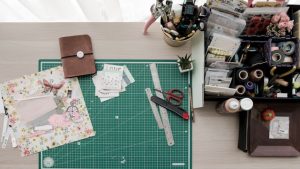
Photo by Volodymyr Proskurovs from Unsplash
The Monthly Junk Journaling Workshop is guided by established best practices in library planning, emphasizing intentional design, sustainability, and community responsiveness. Michael Stephens and Michael Casey’s work on Taming Technolust underscores the importance of avoiding trend chasing and instead focusing on thoughtful, mission aligned innovation. Applying these principles, the workshop prioritizes accessible materials, realistic staffing expectations, and a clear understanding of patron needs rather than adopting overly complex or resource heavy approaches. The Technoplans vs. Technolust framework further reinforces the value of planning programs that are sustainable, adaptable, and grounded in community benefit rather than novelty.
WebJunction’s guidance on arts and crafts programming in libraries highlights several essential policies: ensuring equitable access to supplies, maintaining a safe crafting environment, and fostering creativity through low barrier activities. In alignment with these recommendations, the workshop will provide a limited selection of basic materials while encouraging participants to bring their own items for reuse. Clear guidelines will support safe tool use, respectful collaboration, and responsible cleanup practices. These policies ensure that the workshop remains welcoming, sustainable, and manageable for staff while offering patrons a meaningful creative experience.
Timeline for Implementation
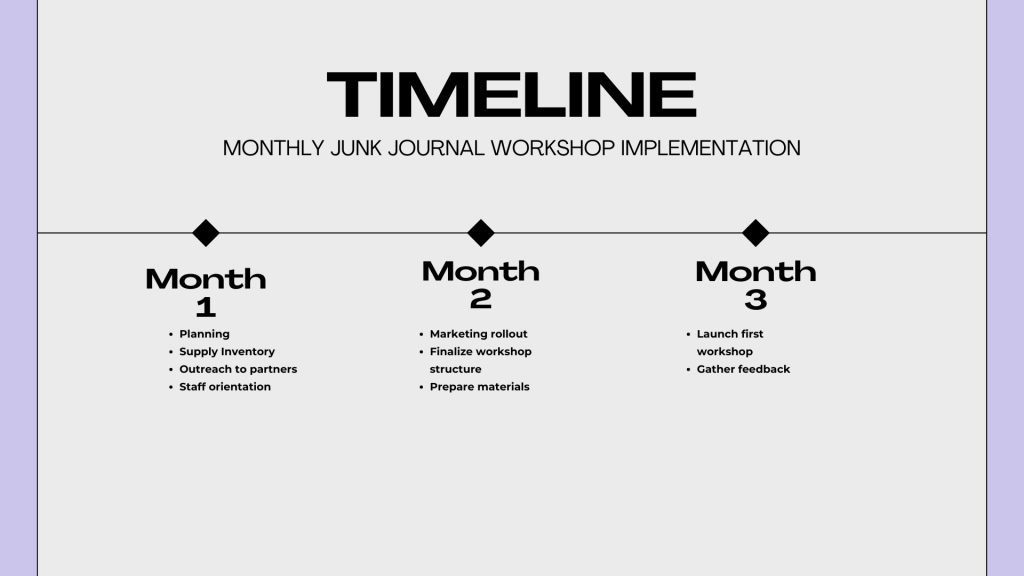
The implementation of the Monthly Junk Journaling Workshop will follow a phased, intentional timeline that supports sustainable planning, staff readiness, and effective community outreach. Month 1 will focus on foundational preparation: identifying available supplies, determining additional materials needed, and establishing partnerships with local artists or craft friendly organizations. During this phase, staff will also finalize the workshop structure, including session length, themes, and facilitation roles.
Month 2 will focus on promotion and internal readiness. Marketing materials like blog announcements, social media posts, flyers, and calendar listings will be released to build community awareness. Staff will participate in a brief orientation covering junk journaling basics, safety guidelines, and supply management procedures. A small reserve of recycled materials will be collected through staff contributions and optional patron donations.
Month 3 will mark the official launch of the workshop. The first session will serve as both a creative program and a feedback opportunity, allowing staff to gather participant insights and adjust future sessions accordingly. Ongoing monthly sessions will incorporate evolving themes, seasonal prompts, and opportunities for patrons to share their journals, ensuring continued engagement and growth.
Marketing and Promotion
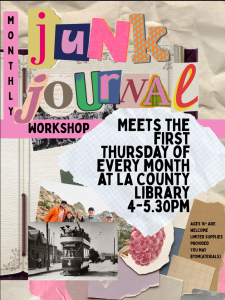
Marketing Flyer Mockup
Effective marketing and promotion will ensure that the Monthly Junk Journaling Workshop reaches its intended audience of teens (16+) and adults who are seeking creative, low pressure opportunities for self-expression. The promotional strategy will emphasize accessibility, sustainability, and community connection. Messaging will highlight that limited supplies are provided, participants are welcome to bring their own materials, and no prior artistic experience is required. Promotion will occur across multiple channels to maximize visibility. The library’s website and blog will feature a dedicated post introducing junk journaling and showcasing sample pages from the facilitator’s own journal. Social media platforms will share visually engaging posts, including close up images of journal spreads, recycled materials, and workshop themes. Flyers and posters will be displayed in high traffic areas within the library and distributed to local schools, community centers, and partner organizations. Additionally, staff will promote the workshop during related programs, such as teen activities, adult crafting sessions, and makerspace events. This multichannel approach ensures that the workshop is visible, inviting, and positioned as a meaningful addition to the library’s creative programming.
Staff Training and Readiness
Successful implementation of the Monthly Junk Journaling Workshop requires staff who feel confident facilitating creative, mixed media activities and managing flexible, low barrier crafting environment. Staff training will focus on three core areas: program familiarity, material management, and participant support. First, staff will receive a brief orientation in junk journaling techniques, including collage basics, layering methods, and creative reused strategies. This ensures that facilitators can demonstrate simple approaches while encouraging patrons to explore their own styles. Second, staff will review supply organizations and safety guidelines, including appropriate use of scissors, adhesives, and mixed media materials. Clear procedures will help maintain a welcoming and orderly environment. Finally, training will emphasize inclusive facilitation practices like supporting patrons of varying skill levels, encouraging experimentation, and fostering a collaborative atmosphere that aligns with the library’s mission of connection and creativity.
Evaluation and Future Expansion
Evaluating the Monthly Junk Journaling Workshop will ensure that the program remains responsive to community needs and aligned with the library’s mission of fostering creativity, connection, and sustainable learning. Assessment will focus on both quantitative and qualitative measures. Quantitative indicators include attendance numbers, repeat participation, and supply usage trends. Qualitative feedback will be gathered through brief post program surveys, informal conversations with participants, and staff reflections on facilitation and engagement. Social media interactions such as shared journal pages, tagged posts, or workshop highlights will also serve as indicators of community enthusiasm and reach.
This evaluation process will guide future expansion. If interest grows, the workshop may incorporate themed sessions (e.g., gratitude journals, travel memories, seasonal prompts), collaborative journal swaps, or opportunities for patrons to display their creations in the library. Partnerships with local artists, makerspaces, or sustainability organizations could enrich future sessions and broaden community involvement. Additional age specific workshops such as teen-only or adult-only sessions may be introduced based on demand. Through ongoing assessment and thoughtful adaptation, the workshop can evolve into a signature creative program that strengthens community connection and supports lifelong learning.
Conclusion
The Monthly Junk Journaling Workshop represents a meaningful and mission aligned addition to the library’s creative programming, offering patrons a welcoming space to explore self-expression through sustainable and hands on artmaking. By centering accessibility, community connection, and creative reuse, the workshop reflects the library’s commitment to fostering learning and belonging in ways that resonate with both teens and adults. Grounded in intentional planning, supported by staff readiness, and inspired by successful regional programs, this initiative demonstrates how libraries can continue to innovate while honoring core values of trust, hope, leadership, and connection. As the workshop evolves through ongoing evaluation and patron feedback, it has the potential to grow into a signature program that strengthens community ties and encourages lifelong creativity.
References
LA County Library. (2024). Strategic plan 2024–2028. https://lacountylibrary.org/strategic-plan/
Stephens, M. (2012, May 30). Taming technolust: Ten steps for planning in a 2.0 world. Tame the Web. https://tametheweb.com/2012/05/30/taming-technolust-ten-steps-for-planning-in-a-2-0-world-full-text/
Stephens, M. (2004, November 1). Technoplans vs. technolust. Tame the Web. https://tametheweb.com/2004/11/01/technoplans-vs-technolust/
WebJunction. (n.d.). Library arts and crafts programs. https://www.webjunction.org/news/webjunction/library-arts-and-crafts-programs.html
Downey City Library. (n.d.). Junk journaling. https://www.downeylibrary.org/calendar-of-events/junk-journaling
Los Angeles Public Library. (n.d.). Junk journaling event. https://www.lapl.org/ko/event/10190

@mylifeastori I had no idea what junk journaling was before this. I know you had put a mention of it on a self-care blog post and that intrigued me. I always tell people that I am not a crafty person, so this seems a bit intimidating to me, but in the same sense, it sounds like a wonderful program that can bring different people of different ages together. I like the idea of reusing things and to make it your own. I feel like this would be a neat way to do a story-telling program through imagery. The ability to offer it on a month to month basis and even include themes, holidays, prompts to mix things up adds to the creativity. I know that you wrote that it would be accessible to everyone, however you also said that the library would only be able to provide basic supplies. What about those populations that don’t have the extra money to buy supplies, but want to still be a part of the event? Is there more than just staff and participant donations that could be accumulated for those similar to scholarships for at-risk populations to attend things like camps, etc?
This post made me want to contact our art instructor and see if she would be willing to put together something like this for our college students and hold it in the library. I know it would take some planning, but you got me thinking on this one. Bravo!
@beccaslick You know it’s funny, I’ve always said that I’m not a creative person, similar to you telling people that you aren’t a crafty person. Since I started junk journaling about a year ago, I think I’ve proved myself wrong at this point. But the beauty of junk journaling is that there are no rules…none! It can be whatever you want it to look like. I totally agree with you that this could be a way to integrate story-telling too. With this program I would hope for the library to provide at base level glue sticks, scissors, and blank journals. Since the core of junk journaling is reuse, I even think that weeded books, magazines, and periodicals could also be used if allowed. Also, because there is some level of a personal element of creating a journal, I would also hope that participants would bring some of their own “junk” to use in their journals. As you can see in my above spreads from my own journal, one spread has ticket stubs and Frida Khalo postcard from my trip to CDMX. The other spread I shared, each item used was literally a piece of trash….a tag from a souvenir, the paper bag that held my sweet bread, a piece of a paper placemat from a restaurant a ripped off pieces from my receipt from visiting a museum. In theory, I think that this program has the potential to be low cost because of the reuse element.
I definitely think that this type of program would be a huge hit with college students. I’m really glad it inspired you! My sister hosts a junk journal night almost every month, where a bunch of us gather, share supplies, and add spreads to our journals. It’s so much fun to get to craft together and share in our creativity!