Hyperlinked Symposium: Libraries Beyond Books
In my best of reflection blog post, I will discuss the topics that resonated with me most from my past blogs 2, 3, 4, and 5, covering the topics of the digital divide, embracing social justice, conversation bowls, homeless Tai Chi, human libraries, and digital literacy for children and teens. Although these topics are diverse, they are connected by common themes of libraries as inclusive spaces, digital literacy and equity, and the evolving role of libraries beyond being buildings filled with books. Exploring these topics throughout the Hyperlinked Libraries course helped me realize how much libraries have transformed. They have evolved from institutions centered primarily on book collections into spaces that foster inclusion, support lifelong learning, and provide welcoming environments where people can connect, learn, and thrive.
Digital Literacy and Equity
Initially, when I heard the term digital inclusion, I thought it simply referred to libraries providing internet access and Wi-Fi hotspots for patrons. However, after reading the course modules, I realized that access alone is not enough. Many library patrons from children to seniors need support in developing digital skills, such as learning computer basics, protecting their online privacy, staying safe on the internet, and communicating respectfully in digital spaces. Libraries address these needs by offering public computers, Wi-Fi hotspot lending programs, and digital literacy classes for all ages. Together, these services complement one another and play an important role in promoting digital equity within the communities that libraries serve.
Building Communities
Programs such as conversation bowls, human libraries, and homeless Tai Chi create opportunities for diverse community members to connect, learn from one another, and move beyond misconceptions, prejudice, and stereotypes. By fostering meaningful conversations and shared experiences, these programs help reduce loneliness while building friendships, empathy, and a stronger sense of community.
Libraries and Social Justice
Many libraries are actively working to represent diverse communities and promote social justice in meaningful ways. They do this by eliminating overdue fines, lending Wi-Fi hotspots, and creating book displays that celebrate Black History Month, Pride Month, Asian Heritage Month, National Indigenous History Month, and other culturally significant events throughout the year. Libraries also offer cultural awareness initiatives, STEM programs, and welcoming play and learning spaces for underprivileged children and teens. Together, these services and programs help bridge social and economic divides while creating more inclusive communities. My own experience working at the Toronto Public Library (TPL) has reinforced these ideas and shown me how libraries are embracing hyperlinked principles to make a meaningful impact on people’s lives.
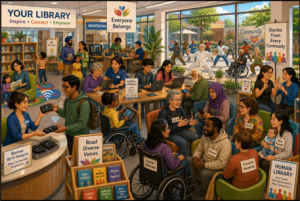
To conclude my adventures through the Hyperlinked Library course, I used ChatGPT to generate an image that brings together my favourite concepts, ideas, and experiences from learning about libraries throughout the course.
This photo shows a Wi-Fi hotspot lending station with a box of hotspots, reflecting my own experience working on this program at my TPL branch. At the centre, patrons of all ages are participating in a digital literacy session led by a library staff member. Nearby, a Human Library program is underway, where diverse community members share their experiences on topics such as autism, military service, refugee experiences, parenting, and the arts. Stories are shared in different formats of spoken language and sign language, which shows the importance of accessibility. Outside the branch, a Tai Chi class is taking place, inspired by the concept of Homeless Tai Chi. This image represents my vision of a true hyperlinked library. It is the kind of library environment I hope to help create in my future career as a librarian at TPL.
Here is the PDF copy link for the image:
One Comment
Jana
I really enjoyed how your reflection brings together so many different examples of what a Hyperlinked Library can be. Your point that libraries have evolved beyond being “buildings filled with books” really resonated with me. Plus, the examples you included, like Conversation Bowls and Homeless Tai Chi, show how libraries create opportunities for connection, belonging, and learning. I also appreciated your comments on digital inclusion and how access to technology is only one part of the solution. Digital literacy is becoming so important for all patrons. Overall, what a great job summing up this course.