I really love this module and that it is included in this course. I personally am a big sharer and contextualizer because I am a big believer that sharing stories will lead to more empathy and understanding and that will lead to stronger communities. I see this both in my personal and professional worlds and am very grateful for the opportunity to continue the exploration of this topic right here.
Like mentioned above, I have a lot of professional experience with stories. One of my most honored experiences was working as a transcript editor for a Spanish language oral history project that produced the first Spanish material to be collected and housed in my college’s archives. The project, called The Listeners Project: Queremos Escucharte (TLP) began with the Colectivo de Arte Social (Socially Engaged Art Collective) which is a “group of creative immigrants and immigrant advocates from the Walla Walla Immigrant Rights Coalition” and is produced in partnership with the Walla Walla Public Library and the Whitman College and Northwest Archives (TLPWW, n.d.). The project collects oral histories of the Latine and immigrant community members that have been left out of the region’s history. The history of the region I was getting from my education was mostly focused on the westward expansion/settler colonialism/indigenous displacement side of things. TLP aims to collect a more recent history of the influx of Mexican and Central American immigrants to the area to work in agriculture and affirm that story among the context of the broader history that includes the aforementioned well recorded history.
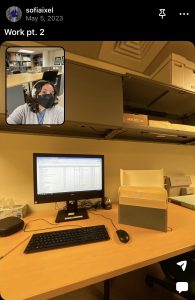
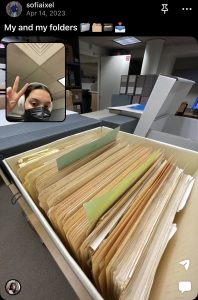
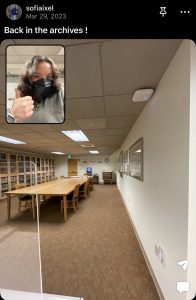
As the transcript editor, I was some of the first people to hear these stories (outside of the interviewer of course). Part of the job too was organizing the notes from the interview and helping the archivists condense them into both Spanish and English finding aids for each of the audio recordings and written transcripts. I am semi-fluent in Spanish so this was an awesome opportunity to keep flexing that language muscle and making sure that these stories would eventually be accessible and findable to all in the community. I know that this project means a lot to the Walla Walla community and has fostered a really great partnership between the community, the public library, and the college. I’m grateful to have had a small part in making it happen.
Separate thought:
Has anyone heard about Book from the Ground: From Point to Point by Bing Xu? In the lecture, Micheal mentioned how Emojis are great story telling mechanisms and I immediately thought of this book! It’s a story about the day in the life of an office worker told completely using emojis, symbols, logos and emoticons. It has no words just symbols and is paired with another art piece by the same artist/author called “A Book from the Sky” that is made up of entirely made up glyphs that looks like traditional Chinese characters. Both are worth looking up they are very cool and thought provoking.
References
Thanks for sharing, Sofia. Your work with the The Listeners Project sounds so meaningful. I think recording, transcribing, archiving, and just keeping history safe is such an important job, particularly now more than ever. With so much tech — and the reliance on it — I fear that data is often overlooked and lost. I recently came across this article: “We’re losing our digital history. Can the Internet Archive save it?” (linked here: https://www.bbc.com/future/article/20240912-the-archivists-battling-to-save-the-internet) that is quite concerning. If not for historians, archivists, and people doing the work you did, I really fear the histories and stories of minority groups in our society would be erased.
Hi Tina! Thanks for linking that article about the internet archive! I am familiar with the website/organization and am a huge supporter of their mission of recording and preserving the history of the web. I feel really fortunate to have been able to work in an archive and do some preserving work myself.
Another really great organization that I did some research on last semester was the Lesbian Herstory Archives which is a community archive in NYC that preserves anything and everything related to the lives of lesbians in North America. It’s physically housed in a brownstone in Brooklyn but they have a great online digital archive that’s fun to look through. Women and queer people are minorities when it comes to historical preservation so the intersectionality of lesbians holding both those identities makes them especially vulnerable to erasure. The mission of the archives is all about preserving lesbian history and memory as the founders saw that their history was being erased and forgotten as fast as it was being created. I know it’s scary to see how so much of our lives these days are at risk of disappearing due to lack of good data preservation, but knowing there are people focused on supporting their community and society with projects like the Internet Archive and the Lesbian Herstory Archives gives me some hope.
This seems like such a fascinating project to be able to participate in! What was the process like for creating finding aids? Condensing information requires making certain judgement calls, and you helped to do this in two different languages – impressive!
P.S. I have not heard of Book from the Ground, but it has immediately been added to my TBR. 🙂
Hi Staci!
So for TLP I didn’t do much of the finding aid writing, I mostly just transcribed and translated the hand written and/or typed notes from the interviewer. I also made sure that names were consistently spelled in the audio transcript and that dates aligned from the audio to the finding aids. The written notes were really helpful with the “fact checking” and copy editing. The archivists and community organizers were the ones who ultimately decided if the notes themselves went in with the records.
I did get the chance to work on finding aids for other more “traditional” archival records where I would write the biographical notes and the scope and sequence sections. I really loved working in the archives and I feel like they are SUPER important to the idea of stories in libraries so I’m happy I was able to connect that experience to this module.
@ssolares this sounds like a very interesting project that you got to work on and enjoyed. You got to read stories that most people have not heard and from a community that needs to be heard. I love that this was a passion project and that it was taken care of with such care and respect. I don’t know if my public library here has done much with oral histories. I know they have a genealogy room, but beyond that, they do not have a special archive room or section or one person really devoted to recording the history of the community I live in. I think it would be a neat idea for them to set up some type of programming that would develop this multi-faceted story that could be findable to everyone.
I had not heard of the book you mentioned above, but it sounds deeply interesting. Will have to go and check it out!
Hi Becca,
Wow a genealogy room sounds really cool! I’m intersted logistically how that works, like what sort of records, artifacts, or databases are available to make that an available program at the public library.
Similar to TLP that I worked with, I think that community oral histories are best when they are run through partnerships between organizations. Because while I believe that the public library would be the best organization to run such a program, I wouldn’t want to force that extra effort onto the staff to get a whole new program started if that wasn’t in their plans. But if a community organization or club wanted to be the one collecting and recording oral histories and ask librarians for help on how best to preserve them, then that seems like the best of both worlds!