Hello,
Here is my report: User Experience (UX) in Libraries.
Click here if you prefer to view the PDF version.
Thanks,
Rae
Hello,
Here is my report: User Experience (UX) in Libraries.
Click here if you prefer to view the PDF version.
Thanks,
Rae
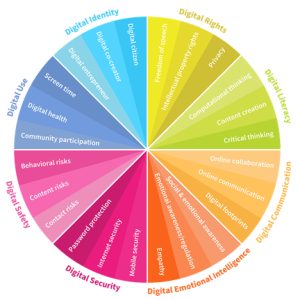 Digital intelligence framework. Note. From 8 digital skills we must teach our children, by Y. Park, 2016, Medium.
I believe cultivating a love of learning is foundational to library work. We can teach a love of learning in various environments through a multitude of methods, which is why I was enthralled with the concept of the library as a classroom. Now, with the growing access to technology, people are learning on the go via their portable devices. Ten years ago, experts predicted that “90% of the entire population will be connected to the internet within 10 years” (Park, 2016, para. 1). At this time, the future has become the present. This led me to ask: How is technology going to impact children, how they learn, and what they need to learn to be prepared for this new era of being connected to the internet?
Park (2016) presents the idea that children need to learn digital intelligence—a “set of social, emotional, and cognitive abilities that enable individuals to face the challenges and adapt to the demands of digital life”—to help them prepare for their digital future (para.6). He explains that there are 8 areas that children need to focus on to gain digital intelligence: digital identity, digital use, digital safety, digital security, digital emotional intelligence, digital communication, digital literacy, and digital rights (Park, 2016).
How can the library be transformed into a classroom that teaches these skills? Rogers-Whitehead (2020) presents some innovative ways in which librarians can participate in teaching digital intelligence to children through the five early literacy practices — Read, Write, Talk, Sing, and Play.
Read: By reading picture books to children about digital safety, digital use, and digital security, children can learn these skills in an interactive and engaging way (Rogers-Whitehead 2020).
Write: Using prompts to ask children about “who they want to be online” will help children identify what image they want to present on the internet and why it is important, giving children an opportunity to learn about digital identity and digital communication (Rogers-Whitehead 2020).
Talk & Sing: Talking to your children about what, why, and how you’re doing things on your device leaves room for open discussion about what a device is and what it can do (Rogers-Whitehead, 2020). If your child seems disinterested, try singing or playing music about digital intelligence instead!
Play: The internet is a playground in its own right. As children get older, they want to join online communities, play games, and create online. However, this can leave them vulnerable to being targeted, especially with the creation of AI. While children are still forming their digital identities, the library can use this time to teach them about digital communication, digital emotional intelligence, digital literacy, and digital rights through interactive games and literacy initiatives using things that they are interested in, such as their favorite anime, stories, characters, movies, and TV shows (Rogers-Whitehead, 2020).
As Stephens (2016) writes, “libraries of all kinds also serve as creative classrooms” (p.127). This means librarians have a unique opportunity to turn any space into a classroom. By being creative and leaning on your community, other librarians, or subject experts, we can create access to skills that are needed for success inside and outside the classroom.
References:
Park, Y. (2016, June 14). 8 digital skills we must teach our children. Medium. https://medium.com/world-economic-forum/8-digital-skills-we-must-teach-our-children-f37853d7221e#.789qtaw64
Rogers-Whitehead, C. (2020, November 2). Digital citizenship for librarians—Five IRL and digital program ideas. Connected Learning Alliance.https://clalliance.org/blog/digital-citizenship-for-librarians-five-irl-and-digital-program-ideas/
Stephens, M. (2016). The heart of librarianship: Attentive, positive, and purposeful change. ALA Editions.
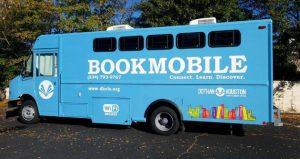 Bookmobile from Dothan Houston County Library System (N.D)
I felt a personal connection to the Power of Stories module, particularly after reading How Libraries Save Lives by Maria Popova. The quote, “You never know what troubled little girl needs a book,” is one that I relate to deeply (Giovanni, as cited in Popova, 2016). As a child who grew up in poverty in a single-parent household, I was once that troubled little girl, and libraries were there for me. Like Storm Reyes, I experienced how the power of stories can help people believe that they too have a place in this big world (Popova, 2016).
A common theme I noticed throughout this module is that the impact libraries had on people’s lives often extended beyond the physical library. As Margaret Snyder shared, when librarians are trying to offer “alternative ways of learning or experiencing the world, if it’s something you can only do when you’re in a physical space, then it’s limiting the impact that the library can have” (Library 2.0, 2020, 30:45). As demonstrated by Storm Reyes’s story, information professionals must be willing to think of ways that our services can reach patrons who otherwise would not have access to a library.
The power of stories is real, but so are book deserts. I believe that bookmobiles, such as the one that Reyes’s experienced and the one used by Gwinnett County Public Library, are an effective way to expand a library’s reach. By showing up in parks, neighborhoods, Boys & Girls Clubs, YMCAs, and rural towns, libraries can reach users who might not otherwise have the chance to pick up a book (Gwinnett County Public Library, 2022). Ms. Maze’s story is another example of this approach. Her story went viral on TikTok for creating a mobile book trolley that travels throughout Baltimore to improve literacy by providing free books to children living in book deserts (Brockington, 2026).
As an aspiring librarian, I hope that just as Reyes’s librarian did for her, the Gwinnett Public Library does for their community, and Ms. Maze does for Baltimore, I, too, can provide true access to all the troubled people—both young and old—who need a powerful story.
References:
Brockington, A. (2026, September 21). This woman is bringing free books to hundreds of kids with magical trolley. TODAY.com. https://www.today.com/life/free-book-trolley-storybook-maze-interview-rcna599090
Gwinnett County Public Library. (2022, July 7). Library on the move [Video]. YouTube. https://www.youtube.com/watch?v=NA31m5pnHOA
Library 2.0. (2020, March 11). The power of stories [Video]. YouTube. https://www.youtube.com/watch?v=dvZlTRTVX10
Popova, M. (2016, October 6). How libraries save lives. The Marginalian. https://www.themarginalian.org/2016/10/06/libraries-storycorps-bookmobile/