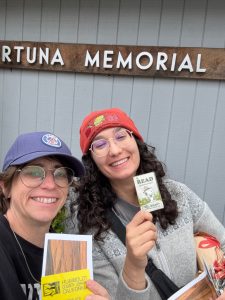
For my Assignment X, I was curious about the ways in which libraries globally are pushing forward the idea of what a library can be. What are some ways communities are shifting and changing to meet this moment of information overload and slop, and continuing to provide access to information, media, and tools. I am interested in how libraries support creatives and encouraging people to connect and create in a time where algorithms are companions and critical thinking can be farmed out.
The first time I saw a library as a “technological-intellectual infrastructure” (Mattern, 2014), was visiting the Central Branch of the Vancouver Public Library in 2018. I was visiting my aunt and walked around in awe after their Phase One redesign (Vancouver Public Library Foundation, n.d.) I remember a hum of activity on the first floor, and it was clear that the library was offering a third space right in the heart of downtown as a space for people to meet and collaborate. From our reading we have the Danish example of Library as a Universe through the Mindspot program out of the Aarhus Public Libraries (transformationlab, 2009). Aarhus continues to bring people together through creative library programming. Its Next Library program gathers librarians to exchange ideas about the future of libraries (Aarhus Public Libraries, n.d.). In collaboration with the Chicago Public Library, Aarhus also helped create a Design Thinking toolkit that supports patron engagement. Aarhus remains committed to expanding the possibilities of what a library can be.
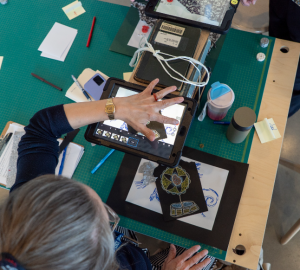
In Helsinki, the Oodi library has been a place for collaboration and a third space. After books, the most borrowed items are spaces (Benke, 2026). The Oodi library and libraries in Finland are thriving, with high usage – over half the population (55%) uses the library at least once a month (Benke, 2026). Finnish libraries and librarians are supporting patrons with digital services. In 2019 all government programs can be accessed digitally, and librarians have taken on becoming digital tutors to support patrons (Ojaranta & Litmanen-Peitsala, 2019). Other services include maker-space materials like sewing machines, laser cutters, 3D printers and heat presses for use in the library.
Different regions of China have adopted varied approaches to meet the needs of their patrons. For example, last year the Ningbo Library broadcast the 700th episode of Tianyi Night Reading, a nightly two-minute video series featuring book recommendations from different people in Ningbo (Ningbo Library, 2025). Recommendations have come from cultural celebrities, truck drivers, craftspeople, and foreigners, reflecting a wide range of community voices (Ningbo Library, 2025). The Ningbo Library has also reported an increase in borrowing rates since Tianyi Night Reading (Ningbo Library, 2025). Ningbo Library has the Tianyi Book Reservation program for patrons to request books by mail for 6 yuan or use the digital library services for patrons unable to make it to the library (Ningbo, 2023). In Foshan, residents can apply to host a Neighborhood Library, commonly known as “N-Library,” a small public library located in people’s homes; this program makes library resources more accessible to community members. N-Library hosts can check out 200 items at a time, while the public library provides literature resources, service support, and assistance in establishing a reading space (International Federation of Library Associations and Institutions, 2021). The N-Libraries have been credited with increasing neighborhood communication and strengthening community ties (International Federation of Library Associations and Institutions, 2021). Beijing has designed a multiuse space that serves the needs of the community, offering a museum space, music venue, and a metaverse experience hall (International Federation of Library Associations and Institutions, 2024). In addition to these services, they also have a 24-hour reading room with self-service check-in and check-outs (International Federation of Library Associations and Institutions, 2024).
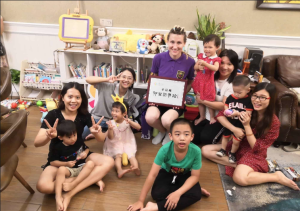
From this very small sampling of how libraries are incorporating hyperlinked library practices (Stephens, 2016), to adapt to meet the needs of the users where they are at. These examples can encourage us to think in ways that are more creative and dream of spaces that better serve our communities. If we think about libraries in a world of possibilities, what can we achieve?
References:
Aarhus Public Libraries. (n.d.). Next library. https://www.nextlibrary.net/
International Federation of Library Associations and Institutions. (2024, November 30). From books to digital worlds: The Beijing Library’s role in shaping a community-centered future. https://www.ifla.org/news/from-books-to-digital-worlds-the-beijing-librarys-role-in-shaping-a-community-centered-future/
Mattern, S. (June 2014). Library as infrastructure. Places Journal. https://doi.org/10.22269/140609
Next Library. (n.d.). Frontpage. https://www.nextlibrary.net/
Ningbo Library. (2023, January 5). The AI services of Ningbo Library. https://en.nblib.cn/information/2723
Ningbo Library. (2025, November 30). “Tianyi Night Reading” has reached its 700th issue, a bookish promise cherished by the people of Ningbo. https://en.nblib.cn/information/2803
Ojaranta, A., Litmanen-Peitsala, P. (2019). Digital skills in Finnish public libraries to engage in the national operating model for digital support for citizens. IFLA WLIC. https://repository.ifla.org/rest/api/core/bitstreams/eb8e82cc-e0dc-47d8-9c2e-b07a613b5fa9/content
Stephens, M. (2016). The heart of librarianship: Attentive, positive, and purposeful change. ALA Editions.
transformationlab. (2009, April 20). Mindspot the movie: The library as a universe [Video]. YouTube. https://www.youtube.com/watch?v=ixsOLvLSARg
Vancouver Public Library Foundation. (n.d.). Central library renewal campaign. Vancouver Public Library Foundation. https://vplf.ca/capital-campaign/