Month: July 2026

Innovation Roadmap: Community Chapters

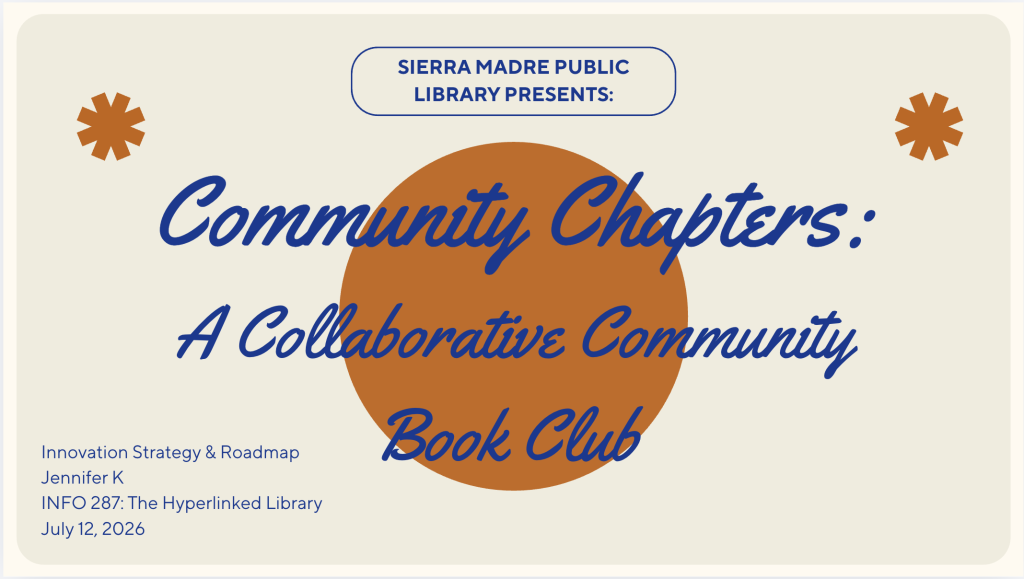
Community Chapters: A Collaborative Community Book Club

“Community Chapters: A Collaborative Community Book Club” is an idea for a program that I’ve been workshopping in my mind for some time now. I enjoyed the process of putting this plan together and thinking about the logistics of pitching and implementing it. While it started with an idea for a shared topic book club with accompanying activities and community connections, the modules encouraged me to consider how I could make it participatory and incorporate a digital option for participation. Beanstack would be a new tool for this library, and I think this would be a great program to introduce it to staff and patrons.


Hyperlinked Environments: Reflections on Denmark’s Impact Compass and Dokk1 Library

With library funding in the United States under continual threat, ALA President Sam Helmick warned that the public and library professionals should not underestimate the lengths that the current administration will go to undercut library funding and support (ALA, 2026). I was craving some inspiration this week, so I decided to explore the international libraries in this module. The Dokk1 Library in Aarhus, Denmark certainly delivers inspiration in spades. This library demonstrates what can be created when a city and its partners invest in meeting the evolving needs of their community. The $305 million project, which took 10 years to complete. Reenvisioned the library as both a cultural center and gathering space (Morehart, 2016). While this library is particularly striking, what stands out to me are the philosophies that guide Denmark’s public libraries.

Through a study that aimed to understand the true value of Danish public libraries, Seismonaut (a Danish innovation consultancy) and Roskilde Central Library developed a tool called the Impact Compass (Lauersen, 2021). I found this effort to shift the language around library success from quantitative measures to more qualitative impacts particularly compelling, especially as libraries expand their services and move beyond being purely book-based. The Impact Compass is explained as a tool to help guide conversations with stakeholders and administrations and a tool to help guide library programs and initiatives (Seismonaut & Roskilde Central Library, 2021). While in the past intellectual impacts may be the first thought that comes to mind when considering the value created by public libraries, the Impact Compass considers the emotional, social, and creative impacts as well. This reflects a culture that values the human needs through togetherness, emotional well-being, imagination, and shared knowledge (Seismonaut & Roskilde Central Library, 2021).
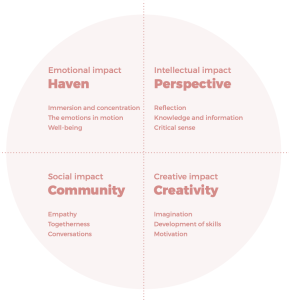
Image from: Seismonaut & Roskilde Central Library. (2021, March). A guide to the Impact Compass – The impact of public libraries in Denmark: A haven in our community. Page 6.

Dokk1 in Aarhus, Denmark is an amazing example of these philosophies in action. It was designed not just for library collections, but for the people it serves. The project manager, Marie Østergård, describes creating a “more liveable city” as one of the goals of Dokk1 (Public Libraries 2030, 2015). This human-centered mindset is evident in the building’s variety of spaces for library collections, meeting and gathering rooms, art and performance areas, playgrounds and more. One art installation that truly encapsulates the philosophy of connection is the Gong that parents at a local hospital can ring remotely to welcome their newborn into the community (Quito, 2022). While each feature is exciting on its own, together they form a clear picture of the values of the community the library serves. Dokk1 demonstrates what is possible when a community views its library not as an expense, but as an investment in its future.
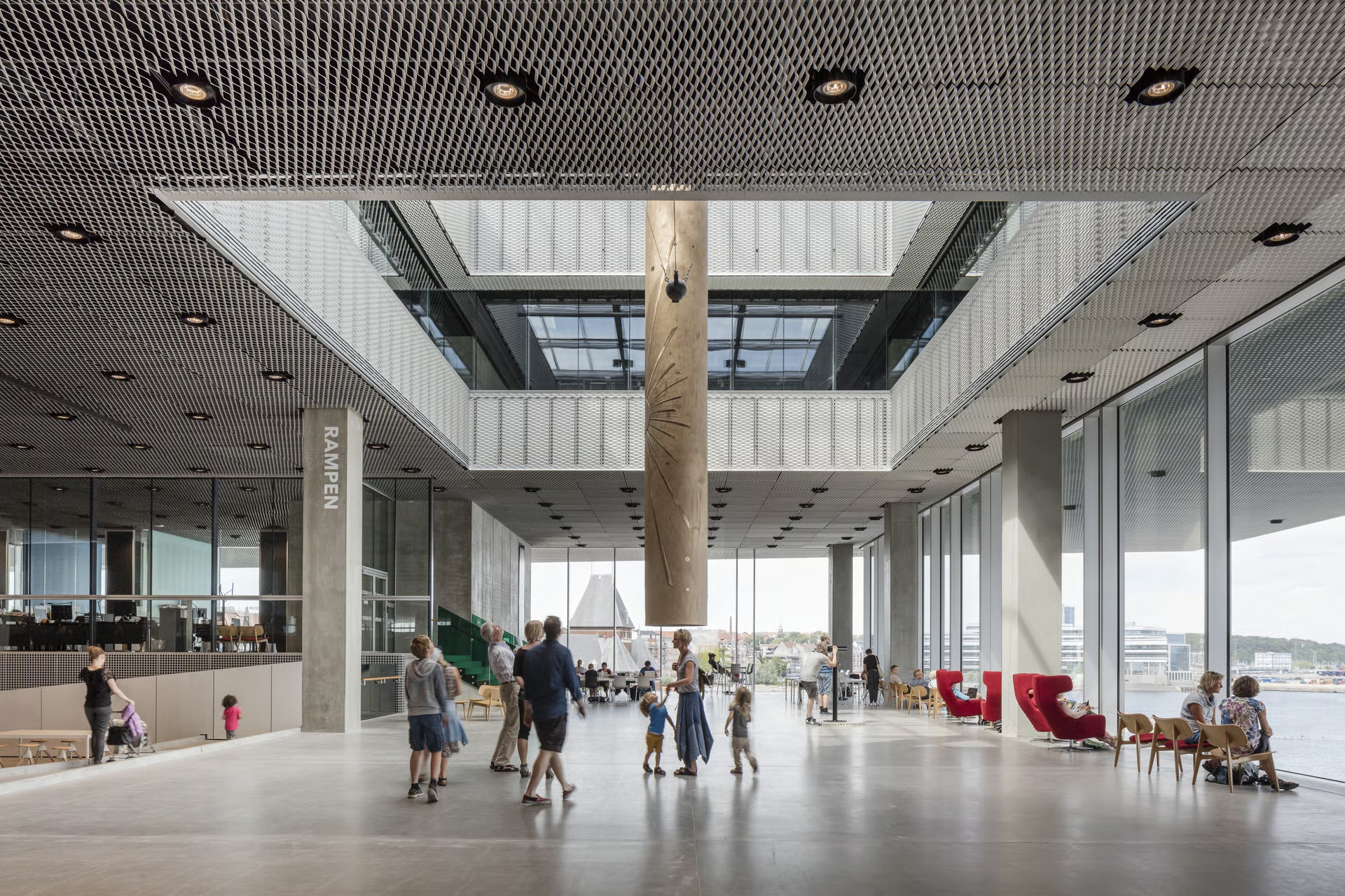
Image from: Quito, A. (2022, July 21). Denmark’s futuristic “citizen space” has been named the world’s best public library. Quartz.

Studying libraries in other countries reminds me of the expansive possibilities in public librarianship. Although the small library I work at could never replicate a $305 million facility, it can take inspiration from Dokk1 and the Impact Compass. As technology continues to change the footprint of the physical collection, we should be considering how the space we do have can be used more functionally and flexibly. Libraries can adopt a human-centered mindset that welcomes the whole person and fits into their lives and aspirations. Fostering community partnerships with other organizations can allow even small libraries to expand their reach to get resources to communities that need them most. I especially like the idea of regularly reviewing library services and programs through the categories of the Impact Compass as a means of gauging how well we’re serving our patrons and allocating energy to areas that need it. While the scale may differ, the underlying philosophy is one I hope to carry into my own career.

References

American Library Association. (2026, April 3). White House FY27 budget proposal repeats threats to eliminate IMLS. https://www.ala.org/news/2026/04/white-house-fy27-budget-proposal-repeats-threats-eliminate-imls

Lauersen, C. (2021, April 19). A haven in our community: The impact and value of public libraries. The Library Lab. https://christianlauersen.net/2021/04/19/a-haven-in-our-community-the-impact-and-value-of-public-libraries/

Morehart, P. (2016, August 17). Moving beyond the “Third Place” – IFLA forum examines library designs that embrace the community. American Libraries. https://americanlibrariesmagazine.org/blogs/the-scoop/library-design-moving-beyond-third-place/

Public Libraries 2030. (2015, April 27). PL2020 Tour – Denmark – A knowledge hub for the community [Video]. YouTube. https://www.youtube.com/watch?v=IvFfbjs8aZo

Quito, A. (2022, July 21). Denmark’s futuristic “citizen space” has been named the world’s best public library. Quartz. https://qz.com/760586/this-futuristic-citizen-space-in-denmark-was-named-the-worlds-best-public-library

Seismonaut & Roskilde Central Library. (2021, March). A guide to the Impact Compass – The impact of public libraries in Denmark: A haven in our community. https://287.hyperlib.sjsu.edu/wp-content/uploads/2022/03/en_brugsguide_06.05.21_0.pdf
Hyperlinked Communities Reflection

This module brought me back to the excitement I felt when I decided to transition into the library field. While my library use dropped off for a period during my first career, I did return as a patron. I had recently relocated to Los Angeles, where the big city library did not disappoint. As a new patron, I discovered the burgeoning Library of Things collections, Memory Labs, and Makerspaces. It blew me away. It was the innovation and community centered approaches to librarianship I saw that really inspired me to get involved. For all the exciting technology, it’s clear that the heart of a hyperlinked library is the communities it serves. Libraries can connect with communities that already exist as well as foster new connections. They are uniquely situated to be community bridges and gathering places, inside and outside of the library walls. A hyperlinked library community is expansive.

While libraries are a comfort place for me, one does not need to physically visit a library anymore to utilize its services or build community. Meeting communities where they are through outreach and events increases library visibility and allows for new connections and partnerships. The “Wash & Learn” pop-up demonstrates how meeting people in the spaces they already utilize regularly offers them an opportunity to access library resources they may not even be aware of. This initiative is the result of multiple organizations forming a partnership and maintaining an initiative that reaches residents in a place they utilize regularly (Bibliothèques Sans Frontières, 2017). Whether taking a bookmobile to a laundromat, farmers market, senior center, or festival, libraries that can meet community members where they are can become more top of mind for those who may not be aware of library services.

Another space libraries can utilize to reach and better understand the communities around them is the digital space. I personally enjoy watching library reels on Instagram. Librarians can create a sense of playfulness and share their personalities in a way that reminds viewers that libraries are welcoming places to have fun and explore. Entire communities exist in purely online spaces, but the people are real, and they are (and can become) library patrons. BookTok connects readers worldwide, with niche communities forming within the larger community. As discussed by Jensen (2022), keeping tabs on popular trends in these online communities can help inform collection decisions and displays, not only for trending titles but also for read-alikes. A hyperlinked library would be wise to both consume and create on BookTok.

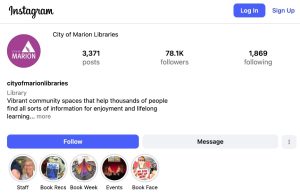
City of Marion Libraries Instagram profile page. (@cityofmarionlibraries, n.d.)

As described by Stephens (2025), when libraries use social media to foster authentic, human dialogue, they can create connection that resonates beyond marketing. One of my favorite libraries to follow is City of Marion Libraries. As demonstrated by their Instagram highlights, social media isn’t only used to share library events. It’s used to engage in online trends and conversations, participate in BookTok trends, and allow the public to get to know the staff (City of Marion Libraries, n.d.). If their online community reflects their libraries, I would expect their physical spaces to feel fun and welcoming and the staff to feel approachable. These qualities invite patrons and communities to feel comfortable reaching out to engage in new ways. 

It is easy to view outreach as a way to encourage people to enter the library, but this module has reinforced that connection works both ways. Libraries must be willing to step beyond their physical and digital boundaries, listen to the people around them, and build relationships with groups and communities that already exist. Whether through a pop-up event, a social media interaction, or a partnership with a local organization, each connection creates opportunities for dialogue, positive associations, and future engagement. A hyperlinked library is not defined only by its collections, programs, or technology, but by the relationships it builds. Those relationships are what allow libraries to remain relevant and active participants in the communities they serve.

References

Bibliothèques Sans Frontières. (2017, October 11).
“Wash & Learn” pop-up library program in the Bronx
[Video]. YouTube. https://www.youtube.com/watch?v=9HM7pQiqDZY

City of Marion Libraries [@cityofmarionlibraries]. (n.d.). Posts [Instagram profile]. Instagram. Retrieved July 19, 2026, from https://www.instagram.com/cityofmarionlibraries/

Jensen, K. (2022, February 10). As seen on #BookTok: Inspiring young readers, TikTok is a boon for books. School Library Journal. https://www.slj.com/story/as-seen-on-booktok-inspiring-young-readers-tiktok-is-a-boon-for-books-libraries

Stephens, M. (2025). Beyond buzzwords: Ten invitations to build library connection and community [PDF]. https://www.dropbox.com/scl/fi/f05u6l0d50k8js28vgokz/Beyond-Buzzwords-Ten-Invitations-to-Build-Library-Connection-and-Community.pdf?rlkey=2i1b76g18h9t2qxmq3s1y7q90&st=of4tisuf&e=1&dl=0