My career before embarking on the MLIS journey involved running community spaces. I worked at a nonprofit, on the edge of two social ecologies: real estate and philanthropy, consulting on community space projects for Google.org, LinkedIn, CZI, and the Golden State Warriors Foundation. I facilitated a network of several nonprofit-centered spaces that uphold the shared vision of facilities that foster connection, including CalEndow, KFF, Omni Commons, and Restore Oakland. Because of this work experience, I immediately resonated with the Four-Space Model (Jochumsen et al., 2012). In the Bay Area, there were plenty of initiatives that tried to answer to all four needs: inspiration space, learning space, performative space, and meeting space. The TEDx Talk embedded below is an example of the conversations that fueled the visions at work.
Replace the term “community space” with “libraries,” and you’ll find there’s plenty of overlap in objectives and shared strategies. The key points in Module 4 highlight how libraries create and facilitate connections. For example, I really enjoyed Shannon Mattern’s piece in the Places journal. Our libraries function as part of infrastructural ecologies:
“And we must consider how those infrastructures can embody the epistemological, political, economic and cultural values that we want to define our communities”, (Mattern, 2014).
Perhaps my favorite aspect of a future in library work is that I can continue committing to the purposeful work of increasing access and bridging communities through participatory practices. As Mattern reiterates:
Public libraries are often seen as “opportunity institutions,” opening doors to, and for, the disenfranchised… A recent report by the Center for an Urban Future highlighted the benefits to immigrants, seniors, individuals searching for work, public school students and aspiring entrepreneurs: “No other institution, public or private, does a better job of reaching people who have been left behind in today’s economy, have failed to reach their potential in the city’s public school system or who simply need help navigating an increasingly complex world.”
It truly takes a village – especially cross-sector partnerships and hyperlinked approaches – to build a resilient safety net for all. When we are hyperlinked, we are less likely to allow each other to fall through the cracks. If social services and resources can be accessed in libraries, if civic engagement, relationship-building, and placemaking can be deepened through library programs and small daily interactions of care, we stand to strengthen the social threads that bind us in a holistic, healthy ecosystem. (Read the 11 Principles for Creating Great Community Places here: https://www.pps.org/article/11steps)
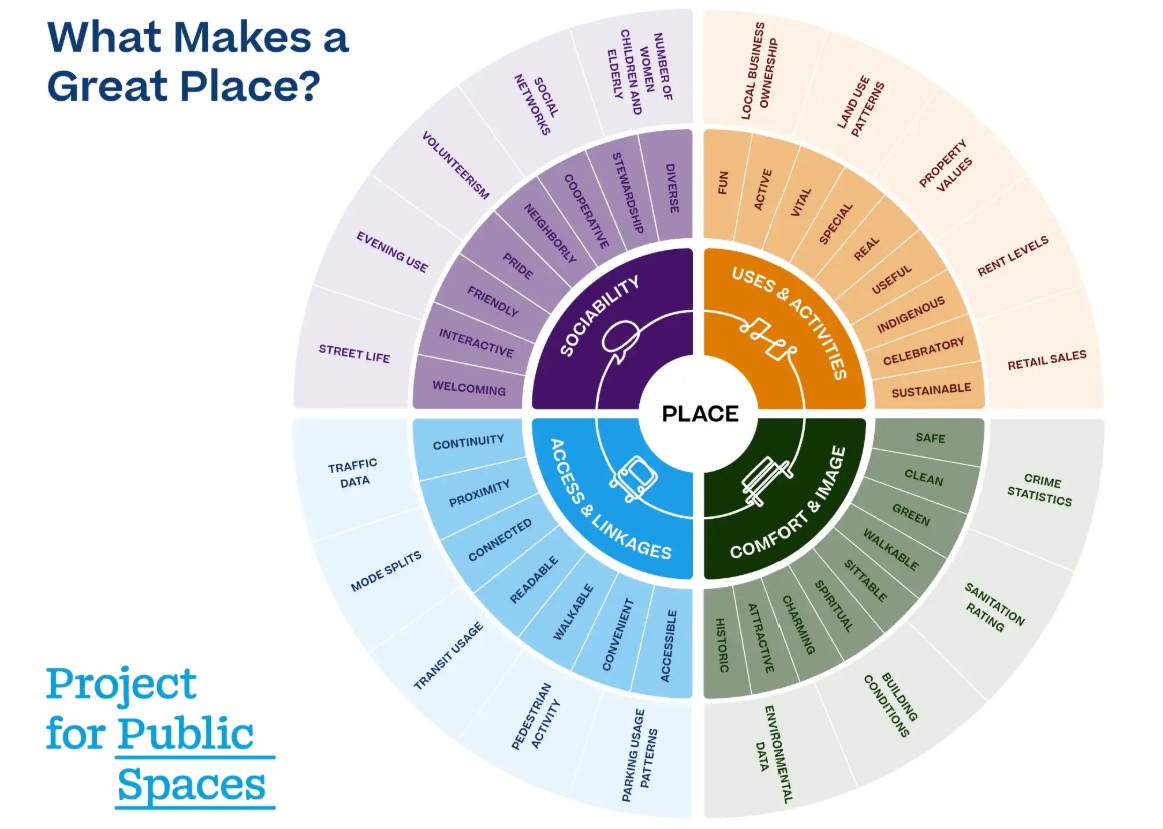
Participatory culture is especially meaningful to me because it brings in voices that are often discounted elsewhere in society. Libraries are where certain people who may not receive the dignity and respect of being treated as patrons, clients, or constituents elsewhere are intentionally welcomed and integrated into the iterative design and evolution of a place they also belong to.
Libraries blend the edges of information science, third spaces, and a rad petri dish of socialism. I’m excited to be entering this field and bring my nonprofit experience to library management and budget-conscious program production. I am inspired by Professor Stephen’s quote:
“We do this with humanity and heart”
References
Jochumsen, H., Rasmussen, C. H., & Skot‐Hansen, D. (2012). The four spaces – a new model for the public library. New Library World, 113(11/12), 586–597. https://doi.org/10.1108/03074801211282948
Mattern, S. (2014). Library as Infrastructure. Places Journal. https://doi.org/10.22269/140609
TEDx Talks. (2021, March 30). Changing the narratives with futuristic thinking: youth engagement | Ilana Lipsett | TEDxArochukwu [Video]. YouTube. https://www.youtube.com/watch?v=7gVMh_kyTVs
What is placemaking? (2007). Project for Public Spaces. https://www.pps.org/article/what-is-placemaking