Reflection
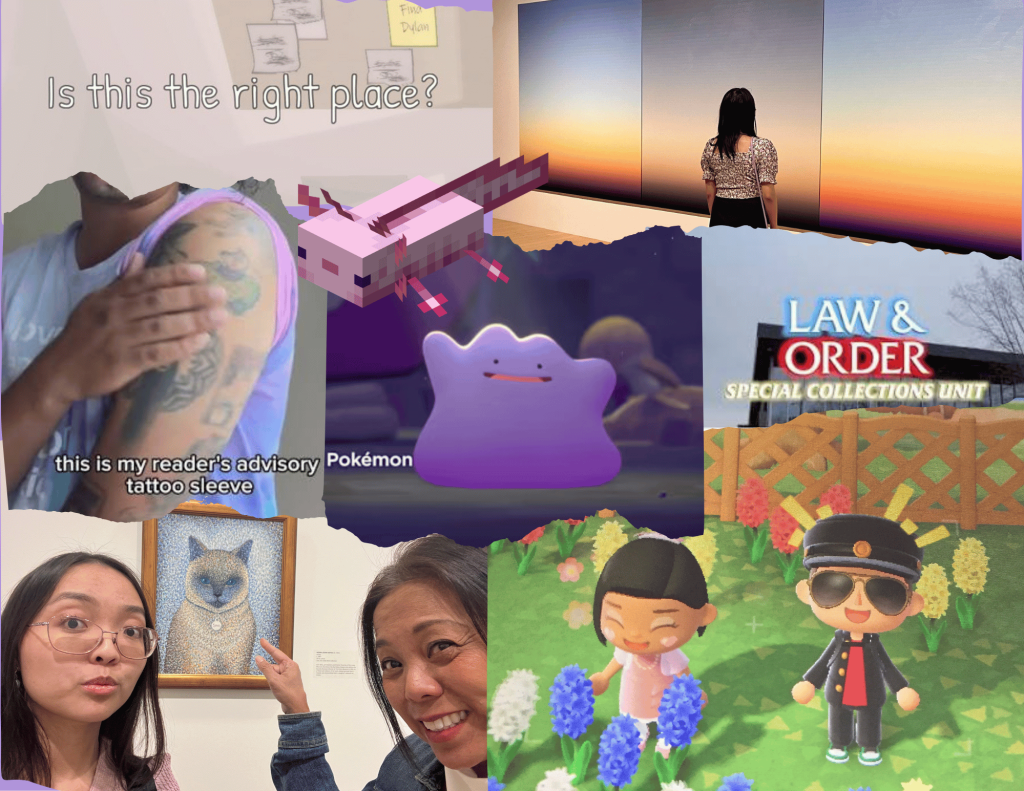
Looking back on my works from this class, there were two subjects I discussed multiple times: social media and video games. This finding doesn’t surprise me as those are probably my two favorite “emerging” technologies. I’m glad I was able to find new facets of these tried and true subjects through Hyperlinked Libraries.
In my personal life, social media and I have had a love-hate relationship. However on an impersonal level, the interactivity, wide reach, and curation features of social media have always fascinated me. One of my first opportunities to volunteer for a library organization was to run the social media account of a local Friends of the Library, so I have had some time and experience with the overlap of social media and library activities. Through Hyperlinked Libraries, I explored how libraries and other GLAM institutions are utilizing social media to engage patrons and curate their image (Charr, 2020; Daily Bruin Staff, 2016; Titlow, 2016). GLAM institutions are now not just competing among themselves; they are competing in the overall attention economy and need to act accordingly (Casey, 2011; Charr, 2020; Daily Bruin Staff, 2016; Stephens, 2016, p. 79; Titlow, 2016). Many GLAM institutions are approaching this reality by staying active on social media and hopping on trends (Charr, 2020; Daily Bruin Staff, 2016; Titlow, 2016). This curates a fun, trendy image that young people are more eager to support (Charr, 2020; Daily Bruin Staff, 2016; Titlow, 2016).
Unlike social media, it’s all love for me with video games. They have been a social outlet, an escape, and a storytelling medium at different times. I had no experience with the intersection between libraries and video games prior to Hyperlinked Libraries. However, I’ve always wanted to demonstrate the educational power of video games because I feel like they get a bad rap. I was inspired by a classmate to propose a Minecraft learning program at my local library (Cruz-Ramirez, 2026). I learned how video games can promote literacy in young people and used that as a bridge to create a story game club program plan (National Literacy Trust, 2020).
I used to think I liked social media and video games for very different reasons, but when I look back on the whole picture, I see an important shared feature: participatory learning. Both of these “emerging” technologies deeply engage the user, and invite and incorporate input. Thus, they align well with the participatory service model modern libraries need to adapt and will likely play a key role in the future of libraries (Casey, 2011). At least, they definitely will in my career.
References
Casey, M. (2011). Revisiting participatory service in trying times — a TTW guest post by Michael Casey. Tame The Web. https://287.hyperlib.sjsu.edu/wp-content/uploads/2026/06/Revisiting-Participatory-Service-in-Trying-Times-%E2%80%93-a-TTW-Guest-Post-by-Michael-Casey-%E2%80%93-Tame-the-Web.pdf
Charr, M. (2020, June 17). How technology is bringing museums back to life. MuseumNext. https://www.museumnext.com/article/how-technology-is-bringing-museums-back-to-life/
Cruz-Ramirez, E. (2026, June 22). Assignment X: Let’s build together!. Delicious in Library. https://287.hyperlib.sjsu.edu/deliciousinlibrary/2026/06/22/assignment-x-lets-build-together/
Daily Bruin Staff. (2016, January 20). The impact of social media, art. Daily Bruin. https://dailybruin.com/2016/01/20/the-impact-of-social-media-on-museums-art
National Literacy Trust. (2020). Video game playing and literacy: a survey of young people aged 11 to 16. https://literacytrust.org.uk/research-services/research-reports/video-game-playing-and-literacy-survey-young-people-aged-11-16/
Stephens, M. (2016). “Communities of practice”. In The Heart of Librarianship, pp. 73-87. ALA Editions.
Titlow, J. P. (2016, February 29). How a 145-year-old art museum stays relevant in the smartphone age. Fast Company. https://www.fastcompany.com/3057236/how-a-145-year-old-art-museum-stays-relevant-in-the-smartphone-age