
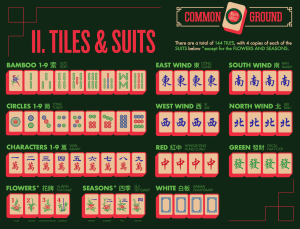
Photo Credit: Common Ground Mahjong Guide designed by Gage Nguyen
Idea Overview
At “Mahjong Social Club”, adult patrons will learn how to play mahjong and learn how to respectfully engage with the cultural artifact of mahjong. Mahjong is a traditional Chinese tile game for four players involving strategy and luck. Partnering with an existing local group Open Table Mahjong Club (2026), all skill levels and Asian diaspora styles are welcome, and they will be teaching Hong Kong style for beginners.
“Playing mahjong is a popular intellectual and social leisure activity in Asian countries” (Tse et al., 2024). King County Library System (KCLS) will seek to co-create a mahjong social club at the public library with Gen Z and Millennial Asian American leaders in the local mahjong community. Led by the keepers of cultural knowledge and memory, Mahjong Social Club at the public library will provide a recurring space that empowers young Asian American diaspora to connect with cultural resources and find solidarity in community.
Mission & Institutional Context
KCLS (n.d.) mission is to inspire the people of King County to succeed through ideas, interaction and information. Mahjong Social Club helps envision a world where knowledge allows diverse communities to prosper and grow. Right now, a Mahjong Social Club provides a cultural oasis for communities oppressed by ongoing Sinophobia and xenophobia to recharge in and remember that immigrant joy belongs here.
KCLS (n.d.) values are outlined below:
- Diversity Equity and Inclusion: Teaching our public library patrons how to play mahjong comes with the responsibility of equipping patrons with knowledge of its cultural origins.
- Knowledge: Adult patrons will learn the basics of how to engage with the cultural artifact of mahjong in a respectful manner. Topics may pertain to understanding positionality, how to speak up, how to receive feedback, and how to research cultural questions and concerns.
- Stewardship: Our meeting rooms provide a safe third space for our community to thrive in. We can diversify our outreach efforts by serving this demographic.
Action Brief Statement
Convince our Gen Z and Millenial patrons that by joining Mahjong Social Club they will learn how to play mahjong and how to respectfully engage with the cultural artifact of mahjong which will grow knowledge of Asian American history, language, research, and relational skills, because our public library inspires the people of King County to succeed through ideas, interaction and information.
Sources of Inspiration
- Mahjong Sparks a New Social Revolution in the U.S. as Gen Z Launches “Pop-Up Mahjong Clubs” https://www.bastillepost.com/global/article/6096341-mahjong-sparks-a-new-social-revolution-in-the-u-s-as-gen-z-launches-pop-up-mahjong-clubs
- Mahjong Club at San Francisco Public Library, CA https://sfpl.org/events/2026/10/24/social-mahjong-club
- Introduction to Chinese Mahjong at Pierce County Library, WA https://calendar.piercecountylibrary.org/event/11649731
- Queer Trans Mahjong Club, WA https://southseattleemerald.org/community/2026/02/27/qt-mahjong-club-turns-game-night-into-space-for-queer-asian-community
- Taiwanese Mahjong Club at San Jose Public Library, CA https://sjpl.bibliocommons.com/v2/events/699ca8673cc3e0c9ecbb1787
- Chinese Mahjong for Beginners at Los Angeles Public Library, CA https://www.lapl.org/events/mahjong-beginners
- Chinese Mahjong at La Quinta Public Library, CA https://laqlibrary.substack.com/p/this-week-at-the-la-quinta-library-08b
- Mahjong mania: What’s behind the rise of a centuries-old Chinese game in the US https://www.cnn.com/2026/09/19/business/mahjong-is-exploding-in-popularity-but-does-it-defeat-the-purpose-of-the-game
- Why a game gaining popularity in the U.S. is giving Chinese factories a needed boost https://www.npr.org/2026/10/22/nx-s1-6012774/why-a-game-gaining-popularity-in-the-u-s-is-giving-chinese-factories-a-needed-boost
- Mahjong Pickleball Rave by Emerald City Tile Club https://www.instagram.com/p/DawKrfuK8On/
- Mahjong is Political by Common Grounds Mahjong Club https://www.instagram.com/p/Ddz3OOfjz-8/
- Mahjong Guides by Common Grounds Mahjong Club https://docs.google.com/spreadsheets/d/1TPFHv__l99TXjGGGSClLm4v5_a9BhQSvKRm-dl7Lae8/edit?gid=0#gid=0
Guidelines & Policies
KCLS will learn from existing Asian American mahjong club organizers that champion social justice. Common Ground Mahjong has robust community guidelines that address oppressive behavior, positionality, privilege, good faith, call-ins, and kindness. https://commongroundmahjong.com/community-guidelines/ KCLS will co-create community guidelines with an existing Asian American mahjong club. All skill levels and Asian diaspora styles are welcome, and they will be teaching Hong Kong style for beginners.
Ethical issues: There will not be American mahjong. Educational resources surrounding the history of mahjong, cultural appropriation, and language erasure can be co-curated and shared to educate attendees. Topics may pertain to understanding positionality, how to speak up, how to receive feedback, and how to research cultural questions and concerns. Attendees should not have the expectation of being a cultural educator to other attendees; the library should support organizers in being the cultural information navigators that help patrons find what they wish to learn more about. Conflict management guidelines should be shared with attendees. For example, if an attendee notices a racial microaggression or feels offended by a lack of cultural humility from another attendee, what are the best practices in this space? KCLS Equity and Social Impact team, KCLS staff with relevant cultural experience (speaking a language, sharing a cultural identity) should be consulted as well. Guidelines should cover Gambling is banned. What community guidelines could transpose directly into the public library, and which ones would need to be modified?
Access issues: mahjong social club may choose to implement themed days for learning various Asian diaspora styles of mahjong. “All players (except the winner) rotate out after two games to give everyone a chance to play” (Common Ground Mahjong). Discuss guidelines for masking as requested.
Operational issues: mahjong tables and chairs will need to be purchased, set up, cleaned up, and stored. Cultural significance of mahjong setup (cardinal directions) may be helpful to research. Organizers may already have their own grants, or KCLS will need to find a grant. Tables must allow four players to comfortably sit in a circle and reach into the middle of the table for tiles. Tile washing sounds may be loud. Keep the sink equipped with soap, paper towels, and hand sanitizer.
Timeline for Implementation
- Staff Training & Readiness – In the first month, library staff involved with this program will learn how to play by attending at least two mahjong events run by Asian American Gen Z adults in the local community. Relevant staff could be the librarian, KCLS social media volunteers, and any interested staff at the branch. Observe how mahjong is taught to beginners, get to know the organizers and attendees. Get curious about why community members repeatedly show up for these events and familiarize with cultural etiquettes of the game. Gather feedback from library staff who share the cultural identity and who do not share the cultural identity to inform the community guidelines discussion. Mahjong learning resources will be provided by the mahjong group organizers.
- Purchasing & Scheduling – In the second month, library staff will tour mahjong organizers of the library space to plan for how many tables and chairs will be needed to host a mahjong event at the public library. Purchase mahjong equipment as advised by the cultural community. Library staff and organizers together will finalize community guidelines for the Mahjong Social Club at the library, and decide what procedures and resources may be helpful for cultural education or cultural conflicts. Community guidelines and cultural resources for difficult topics should be available physically and digitally at every event. Poll existing mahjong community members for the best time to meet at the library.
- Marketing & Promotion – In the third and fourth months, Mahjong Social Club should create promotional material and start the events. There will be four Mahjong Social Club Soft Launch events, every other week. Within the organization, be transparent about the library’s plan to start a Mahjong Social Club at the public library, and invite library staff to attend existing mahjong events. When library staff have first-hand experience navigating the cultural space of playing mahjong, they have a better chance of promoting it to patrons. To reach external users or community, KCLS social media team will co-create an Instagram post or reel with the mahjong group organizers. Since it will appear on the mahjong group organizers’ Instagram page, it will reach existing mahjong networks. The story or message can emphasize what the library has to offer before or after playing mahjong.
- Evaluation & Future Expansion – Count number of attendees. Ask what draws patrons to playing mahjong. Ask what styles patrons play. Ask where else patrons play mahjong and how often. Success stories may touch on why this event strengthens a connection to cultural knowledge and community or gaining confidence in navigating a cultural conflict. This service may grow or evolve over time through supporting patrons’ political organizing (example: mahjong melts ice by Common Grounds Mahjong) or doing multicultural storytimes for adults who wish to learn their ancestral language. The library can explore world language support for patrons to learn how to accurately pronounce language in Asian variants of mahjong. Provide a feedback form at every event.
Concluding Note on Planning for Participatory Services
Public library is about participatory service. “The Pew report is evidence that tapping in to community needs and interests is paramount for libraries, and active interaction with citizens, businesses, nonprofits, and other entities will yield a promising future. Open the doors to local experts and creators to teach and share” (Stephens, 2016, p. 11). Public library staff should co-create Mahjong Social Clubs with Asian American mahjong organizers and library staff that share the cultural identity. This co-led involvement should touch every point of the implementation: staff training and readiness, purchasing and scheduling, and evaluation and future expansion. Mahjong Social Club would not just be a space to meet, but a space to learn and inspire.
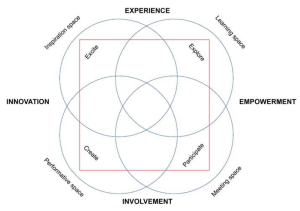
Pictured: The four spaces – a new model for the public library (Jochumsen et al., 2012)
Common Ground Mahjong. (n.d.) Community guidelines. https://commongroundmahjong.com/community-guidelines/
Jochumsen, H., Rasmussen, C., & Skot-Hansen, D. (2012). The four spaces – a new model for the public library. New Library World, 113(11/12), 586–597. https://doi.org/10.1108/03074801211282948
King County Library System. (n.d.). Mission, vision, and values. https://kcls.org/mission-vision/
King County Library System. (2025, December 31). Community demographic analysis: Rivierview region. https://cdn-web-main.bibliocms.com/wp-content/uploads/sites/20/2026/05/2025-KCLS-Demographic-Analysis-Report_Riverview.pdf
Open Table Mahjong Club [@opentablemahjongclub]. (2026, September 5). 🍁Fall + Winter Schedule ❄️We’re back at it & got a packed rest of 2026! Super excited to [Photo]. Instagram. https://www.instagram.com/p/Dc5kVjGGwrN/
Stephens, M. (2016). The heart of librarianship: Attentive, positive, and purposeful change. ALA Editions.
Stephens, M. (2019). Wholehearted librarianship: Finding hope, inspiration, and balance. ALA Editions.
Tse, Z. C. K., Cao, Y., Chau, B. K. H., Yeung, M. K., Leung, C., & Shum, D. H. K. (2024). Does playing mahjong benefit older individuals? A scoping review. The Journal of Prevention of Alzheimer’s Disease, 11(5), 1363–1377. https://doi.org/10.14283/jpad.2024.102
2 responses to “Innovation Roadmap: Mahjong Social Club at the Public Library”
Hey, @innerchildlibrarian. I think this is such a great idea. I especially love how your strategy incorporates/partners with the already existing social infrastructure and leadership in the mahjong community, drawing on their expertise to enhance the program’s effectiveness and reach. Also, the mahjong pickleball rave you linked to really caught my eye–kind of something there for everyone. I love the concept of having different activities going on in a shared space. Just a really enjoyable read, you did a great job.
I think the Mahjong Social Club is a thoughtful and meaningful way for the public library to build community while honoring cultural knowledge. I especially appreciate that your plan emphasizes partnering with Asian American mahjong organizers, creating respectful guidelines, and educating participants about the game’s history rather than treating it only as entertainment. This program could help patrons develop social connections, learn about Asian American culture, and see the library as a welcoming space for cultural exchange and belonging. I have always thought this game looked fun and have always wanted to give it a try! I always thought the tiles looked so fun and satisfying when they are moved around during a game.