
Corporations don’t have voices. They don’t have mouths to speak with, or hands to type with, or body language to betray their real intentions, or eyebrows to punctuate a joke. Corporations are legal fictions. But businesses aren’t fictions. Businesses are as real as families and nations. As with all social entities, they speak as the sum of the parts, as the individuals who are the parts, and everything in between. A business has a voice. You can usually hear it — authentic or unauthentic — most obviously and transparently, on its Web site. (Weinberger, 2001, p. 99)
(In my opinion, libraries are neither corporations nor businesses.)
Dear fellow library and information professionals,
Can you think of the last time a library social media account made you laugh? Public libraries are participating online, going viral, and exploring what it means to create funny, good, and playful content on the internet. “We Need to Be Human. That’s my favorite principle of Library 2.0: the library is human. Communication, externally and internally, is in a human voice” (Stephens, 2019, p. 8). I am fascinated by public libraries moving away from corporate speech and developing a human voice on social media.
Weinberger (2001, p. 99) disapproves of how corporate culture produces employees that must pretend and lie about having a personal life. As public libraries create more social media content, I predict a similar phenomenon will occur: an external and internal cultural expectation to depict library workers as only positive or neutral voices. I attribute these challenges to stem from vocational awe and fear of transparency.

“Sometimes we run from our fallibility by being decisive” (Weinberger, 2001, p. 90). Does a library feel safe from fallibility by only ever using a positive or neutral voice? “To be human is to be imperfect” (Weinberger, 2001, p. 90). A hyperlinked library model can guide public libraries through fear of making mistakes on social media. A librarian who brings his full human voice to the internet is Mychal Threets. He does not obfuscate his online voice to only talk about positive or neutral topics. He lets it known that he has uncomfortable emotions: https://www.instagram.com/reel/Dc4g_dcP52d/
This week, I shared a library meme I enjoyed with fellow library students, which spurred on reflections on the humanness of library workers: https://www.facebook.com/reel/2247917162625067
I appreciated the peer discussion that followed. One Gen X classmate interpreted this video as James Patterson hate, and that librarians are tired of patrons asking for big name authors. I support reading whatever you want at the library. I did not realize videos like that could look like hate on the author; my Gen Z humor accepts it as a meme.
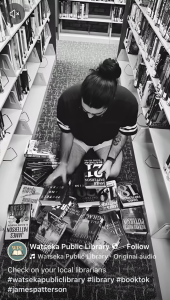
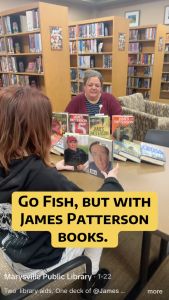
I have seen other libraries making light-hearted jokes about James Patterson. Here’s a library playing a game of Go-Fish with James Patterson books: https://www.tiktok.com/@marysvillepubliclibrary/video/7598359104188402957
However, my classmate’s perspective got me thinking: To what degree is it helpful for public library workers to express uncomfortable emotions, even as a joke on social media? I would not want patrons to feel discouraged or self-conscious about asking library staff for help. Would it have landed funnier if the skit had used “Eye of the Tiger” instead of “Whatcha Say” to depict a library worker in exercise gear who is stretching and gearing up to take on the task of looking through Patterson’s body of work to find the right one for the patron? Same joke of the library having an internal emotional response to the patron’s ask, but now it highlights the library’s enthusiasm to put in the necessary effort to search thoroughly and well.
Maybe this is an in-group meme for some public library workers, and the James Patterson joke is worth moving on from or at least double checking how it lands with its intended audience, public library users. I could see it looking like disrespect to the author, but I think it’s okay sometimes to poke fun upwards at widely published authors. My reasoning is most mainstream authors do not come from a marginalized community with a historic struggle of trying to get their stories published and read. I imagine as more libraries take on a human voice on the internet, discussions like the one I had will happen.
Public libraries are developing their social media voice and figuring out how to share a human side online. While it is acceptable to be neutral or positive, memes can test the public’s tolerance of the library’s humanness, including satirically negative or irreverent jokes. In pursuing a tone of irreverence for relatability and humor, public libraries will risk dropping some pretense that comes with vocational awe.
Besides making jokes out of the books, I hope to see public libraries hone their online voice in a way that adds knowledge to the viewer (Werner, 2015). Milwaukee Public Library memes Wes Anderson films with a deadpan style to promote their genealogy services, and it’s one of my favorite library TikToks: https://www.tiktok.com/@milwaukeepubliclibrary/video/7517322699404807479
Stephens (2019, p. 87) encourages library professionals to look to fields outside the library for inspiration. Here is an announcement from the Washington State Department of Natural Resources. https://www.facebook.com/photo?fbid=1496067742560902. The caption is a great example of using irreverent humor and uncomfortable human emotion to effectively add knowledge to its viewer.
References
Stephens, M. (2019). Wholehearted librarianship: Finding hope, inspiration, and balance. ALA Editions.
Weinberger, D. (2001). The hyperlinked organization. In The cluetrain manifesto (pp. 86-115).
Werner, S. (2015, July 31). How to destroy special collections with social media. https://sarahwerner.net/blog/2015/07/how-to-destroy-special-collections-with-social-media/
3 responses to “Assignment X: Public Library Developing a Human Voice on Social Media”
I currently run the social media for the community college library I work for. Something I am coming to learn is certain posts will only work for certain platforms. We have a much younger audience on TikTok than we do on Facebook, so meme and library humor posts do much better on TikTok than Facebook. Up to this point, I have just been cross posting everything between TikTok, Instagram, and Facebook. However, your point about certain posts not being received the same across age ranges has made me consider adjusting what we post depending on the platform. It is a much bigger time commitment, but it could be important in making sure we aren’t ostracizing one group in the pursuit of another.
Hi Adalie, have you heard of Ruby Karp? Here’s a comedy clip about alleged beef with Facebook when she was 13. https://www.instagram.com/p/DdUOlx6wE6V/
Good point about wanting to check that library social media accounts are not leaving behind one group of people in the pursuit of another. I wonder if we could do a case study of existing libraries how they post differently across social media platforms, and why.