All posts by Chloe

Reflection Post 1: Hyperlinked Communities

A major theme across the Hyperlinked Communities Module, and across the course as a whole, is that the library has functions that go far beyond their widely recognized purpose of housing books. As was discussed by Tareq Nurul Hasan (2022), libraries can be a sanctuary for health and wellness. In her TEDTalk, Ciara Eastell shares how they can be spaces for people to navigate complex emotions, such as grief. They are spaces for both staff and patrons to learn and grow together. 

With this discussion of the wide range of community-centered library functions, this module immediately brought to mind the widely discussed “loneliness epidemic” and the disappearances of third spaces across the United States. According to the U.S. Surgeon General Dr. Vivek Murthy, lack of connection can increase the risk of premature death to levels comparable to smoking 15 cigarettes a day (Summers et al., 2023). As technology has evolved, and culture has shifted, people spend far less time with one another in person as compared to two decades ago. American participation in community organizations has declined in recent decades. In a public health advisory, the very first foundational pillar is the need to strengthen social infrastructure, and the advisory explicitly utilizes libraries as an example. 

Extremely relevant to our course content is the idea that one can be around many people and still feel lonely. According to Dr. Murthy, the actual quality of the connection drives how lonely a person may be. A core question for this module is: How can one foster genuine connection within one’s community? What are ways that librarians can cultivate meaningful and genuine connection in the library spaces?

One way of cultivating meaningful connections that I find to be particularly weighty is for libraries to emphasize the reciprocal learning experiences that can occur in library spaces, and to utilize the knowledge gained from these experiences to create more inclusive systems. A fantastic example of this was the “Wash & Learn” partnership between Libraries Without Borders, The DreamYard Project and the LaundryCares Foundation. In a pop-up library at a local laundromat in the Bronx, students from the community act as librarians to work with fellow community members to answer a myriad of questions. One student noted that many people from their community have information needs but that these people were still waiting to be asked if they needed help. This is an example of learning from community members, and allowing those community insiders to guide work that allows libraries to go to the community, not make the community come to them. 

Another ideal example is the formation of the Black Culture Library Advocates Group at the Multnomah County Library. LeFoster Williams formed and leads an outreach and programming group in the library with the motivation of acting as a voice for the local Black library community. As was discussed in the video, forced diversity makes zero sense without the existence of an inclusive system. Communal experiences are not meaningful, and will not be to our social benefit, if they are not built on genuine efforts toward continuous learning and connection. 

References

American Library Association. (2019, June 17). Multnomah County Library: Creating conditions for equity to flourish. YouTube. https://www.youtube.com/watch?v=SKGlxh-zc0Y&t=114s

Bibliothèques Sans Frontières. (2017, October 11). “Wash & Learn” Pop-Up Library Program in the Bronx. YouTube. https://www.youtube.com/watch?v=9HM7pQiqDZY

Finlay, J., Esposito, M., Kim, M. H., Gomez-Lopez, I., & Clarke, P. (2019). Closure of ‘third places’? Exploring potential consequences for collective health and wellbeing. Health & place, 60, 102225. https://doi.org/10.1016/j.healthplace.2019.102225

Hasan, TN. (2022). “Free, non-judgemental, accessible”: how your local library is a sanctuary of health and Wellness. SBS Bangla. https://www.sbs.com.au/language/bangla/en/article/free-nonjudgmental-and-accessible-how-your-local-library-is-a-sanctuary-of-health-and-wellness/t15blzsi9

Summers, J., Acovino, V., & Intagliata, C. (2023, May 2). America has a loneliness epidemic. here are 6 steps to address it. NPR. https://www.npr.org/2023/05/02/1173418268/loneliness-connection-mental-health-dementia-surgeon-general
Assignment X: The Hyperlinked Library Model and Embodied Practice

When I was an undergraduate studying religion and philosophy at James Madison University, I was particularly interested in the embodied elements of religious practice. Western understandings of religion often give high priority to personal intellectual beliefs and give little thought to the way communal and sensory religious practices are central to religious experience. I came to understand physical behaviors and surroundings to be much more relevant to religious practice/belief and communal participation than I had previously understood them to be and it is for this reason that I am very interested in the physical spaces and actions associated with the hyperlinked library model. 

Embodiment as a significant theme jumped out to me suddenly while I was reading Leferink’s 2018 article for OCLC Next. Leferink focuses on the idea that although libraries have become highly digitized, it is public preference that books remain on display in library spaces. As digital as libraries have become, the actual physical and communal space is still extremely relevant to user experience. Leferink offers tips for improvement to physical library spaces such as designing the space to meet particular user needs and bringing nature into the building. Leferink’s article was a strong starting point, but I quickly realized more of the immense parallels between my interest in embodied practice and the participatory model of the hyperlinked library. 

I feel that a way to understand how the significance of embodied practice/ritual relates to the hyperlinked library model is to see how it is present in some of the characteristics outlined in Dr. Stephens’ Hyperlinked Library White Paper (2011). 

  1. The Library Learns and Plays
    • Experimental play is encouraged for library staff as a form of continuous learning and problem solving. This is highly embodied as staff engage with their environment, patrons, and colleagues. This active engagement leads to discovery and has the capacity to turn thoughts into action. Beyond that, embodied action can reinforce or create new thought!
  2. The Library Connects with Users
    • Conversation is a highly sensory experience, and is also noted in the White Paper as a main way to build connection in community. Connection with one’s library community is foundational and allows patrons to actively participate in building the library experience that they want to see.
  3. The Library is Everywhere
    • Movement is relevant in order for libraries to meet users where they are. Mobile libraries are a fantastic embodied way for libraries to meet their users where they are. I also feel it is relevant to note that embodied practice can still relate to technology. Things like chatting with a friend on Zoom, performing a search for a new recipe, or following a youtube yoga class are all embodied practices, even though this embodiment is facilitated by an electronic device.
  4. The Library Encourages the Heart
    • Encouraging the heart of library users relates greatly to embodied ritual and aesthetic practices. As is stated by Dr. Stephens, encouraging the heart in the library can be things such as putting up beautiful artwork, or having kind and welcoming staff. The physical/virtual space, and the behaviors of the people in it are what encourage the heart for library users.

A large link that I have found throughout this exploration is that both the hyperlinked library model, and religion (through my lens of study) are built through the embodied actions and practices. The hyperlinked library model resists being solely theoretical, as it is the actual action and learning undertaken by both staff and patrons that decides what the hyperlinked library actually is. 

Things to Explore

Here is a link to one of the papers that inspired my fascination with religious embodied practice: https://muse-jhu-edu.libaccess.sjlibrary.org/article/701997

Here is a video that outlines ways for librarians to incorporate personal forms of embodiment into their work: https://www.youtube.com/watch?v=8AtdlLrv8ME

References

Leferink, S. (2018, January 24). To keep people happy … keep some books. OCLC Next. https://blog.oclc.org/next/to-keep-people-happy-keep-some-books/

Ogunnaike, O. (2018). Performing Realization: The Sufi Music Videos of the Taalibe Baye of Dakar. African Arts, 51(3), 26-39. https://doi.org/10.1162/afar_a_00414

Stephens, M. (2011, February 21). The Hyperlinked Library: A TTW White Paper. Tame the Web. https://tametheweb.com/2011/02/21/hyperlinkedlibrary2011/

Intro Post!

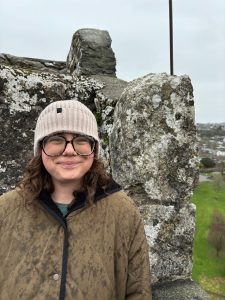
Hi everyone, I am so excited to work with all of you throughout this semester! My name is Chloe, I am located in Northern Virginia, and this is my second to last semester in the MLIS program. I graduated from James Madison University in Harrisonburg, Virginia over a year ago with my BA in Philosophy and Religion and jumped straight into this MLIS program. I am interested in digital asset management and archives. I also had the opportunity to get an intro to web development in a course that I took over the summer, and it is a growing interest for me!  I do not work for a library/info organization yet, but I currently teach music, art and yoga classes to 3-5 year olds, and enjoy listening to music, spending time with friends and family, crocheting, and pilates in my free time. Here is a picture taken on my recent trip to Ireland on top of Blarney Castle: