For this reflection, I decided to focus on International Libraries to tie it back to my previous reflection regarding hyperlinked libraries and English language learners. One thing that came up when I was researching that topic, and something I encounter with patrons while working, is how a lot of new patrons coming in are unfamiliar with how public libraries work, sometimes due to how libraries are perceived or are utilized in the countries they are from. Drawing off of this, seeing how libraries are internationally and what kinds of services are available for patrons seemed like the right direction.
Pezutto (2026) discusses how libraries are perceived in Japan, and right away the first observation is how it is not as common in comparison to public libraries in the United States. There is a disconnect in community engagement and in having accessible services and resources for patrons. However this is combatted through a few approaches, in particular architectural design. Architectural design in the buildings is integral in making a library an open and welcoming space for patrons and having a purpose in mind for who the library is meant for, such as the Nakanoshima Children’s Book Forest.
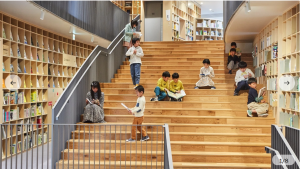
Photo: Shunsuke Ito
This is an approach that can be seen with the DOKK1 Library in Denmark as well. DOKK1 somehow manages to fit every type of resource or service for any type of patron with quiet spaces, gaming rooms, playgrounds, cafes, reading rooms, and more! Even though it is a thriving community space, it is still a library and has a robust collection with an attentive library staff.
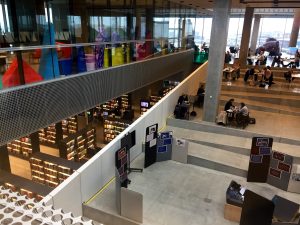
Photo: Ilona Kish
Both of these libraries tie itself to what the community needs and even goes beyond the expectations of what a library should be like. It reflects adaptation and understanding how patrons will use the space beyond what the initial expectations might have been. This can range from the library being a “living room” to a “space of intense work” or the community itself.
References
Morehart, P. (2016, August 17). Moving beyond the “third place”. American Libraries. https://americanlibrariesmagazine.org/blogs/the-scoop/library-design-moving-beyond-third-place/
Pezutto, E. (2026, July 1). Blog #2: Hyperlinked communities: A peek into Japan’s public libraries. https://287.hyperlib.sjsu.edu/wp-content/uploads/2026/07/Pezzuto.pdf
Riain, C. N., & Engberg, J. (2019, February 15). DOKK1 Aarhaus Main Library, Denmark – So good they put it on a stamp. Library Planet. https://libraryplanet.net/2019/02/15/dokk1-aarhus-main-library-denmark-so-good-they-put-in-on-a-stamp/
Time Out. (2025, March 10). Nakanoshima Children’s Book Forest. Time Out. https://www.timeout.com/osaka/things-to-do/nakanoshima-childrens-book-forest
It is so interesting how libraries function differently across the world. I have never been to a library in Japan, but now if I ever find myself with the opportunity I may reflect on their approach they used for their information community versus the libraries here in the US. I like that this reflects how different communities have different needs and expectations when it comes to their community libraries. The Nakanoshima Children’s Book Forest looks like a fun and creative to engage with patrons of the library and to encourage children to interact with books by being able to explore the book forest. This feels like a creative way to encourage a hygge effect at the library for children and their families.