
This week’s module in particular stood out to me because one of the videos this week features one of the services offered by the Gwinnett County Public Library (GCPL) where I work. As a person who grew up in Gwinnett County, I happened to have encountered the buddy branch system a lot while in high school, and it was something that was a source of confusion.
(I actually couldn’t resist tracking down those unusual hours the library had during that time using the Wayback Machine. Check out the screenshot below!)
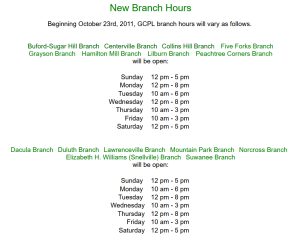
Hearing the explanation of the extended hours as a solution compared to the previous model of the buddy branch system was interesting particularly how it relates to library transparency, and by extension easier access for patrons. This service, especially for new patrons I sign up for library cards, are sometimes still taken aback by the fact that the library trusts its patrons enough to allow this service without staff readily available. I feel this ties into two important concepts introduced in this week’s module: the user is not broken and building and earning trust.
Two of the concepts brought up in Schneider’s The User is Not Broken (2006) is to “meet people where they are” and to “transform the user experience to meet the user.” An example that Kenney (2014) gives is how a service specifically about e-reader help expanded to offering help for other types of devices. The library was able to recognize that this hyperspecific service offered, although nice in concept, was not what the larger community needed and expanded its goal accordingly.
This also ties into how expanded self service hours at GCPL met what the community needed. They would much rather prefer predictability with the library’s service hours, and the extended hours allows for patrons, who are not normally able to use the library, to do so outside of its regular hours. This service demonstrates building trust with the community, and by extension, helps make people successful, which makes for a great user experience (Schmidt, 2013). There was reoccurring feedback from patrons regarding how this service helped them, including: how it’s useful for patrons with long commutes who normally aren’t able to use the library during regular hours, parents with neurodivergent children use the extended hours since it’s quieter, and patrons that work from home use these hours because it’s a time with minimal distractions (Stamm, 2024a).
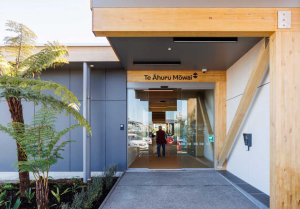
This reaction can be seen in other libraries that utilized this service as well, like the Manawatū Community Hub Library, that realized that, although they renovated the library into a beautiful space, they needed to make the library work for the community. Even the way it’s described on their website, reiterates this:
“… it provides our community with more opportunities to use Te Āhuru Mōwai when it works best for them” (Stamm, 2024b).
Extended hours is just one way out of many that demonstrates how participatory service is essential to how libraries adapt and become accessible to the community it serves. Additionally, it shows how technology can provide unique solutions to services that patrons ask for.
References
Kenney, B. (2014, January 27). The user is (still) not broken. Publishers Weekly. https://www.publishersweekly.com/pw/by-topic/industry-news/libraries/article/60780-the-user-is-still-not-broken.html
Schmidt, A. (2013, November 1). The user experience: Earning trust. Library Journal. https://287.hyperlib.sjsu.edu/wp-content/uploads/2018/09/SchmidtEarningTrust.pdf
Schneider, K. G. (2006, June 3). The user is not broken: A meme masquerading as a manifesto. Free Range Librarian. https://freerangelibrarian.com/2006/06/03/the-user-is-not-broken-a-meme-masquerading-as-a-manifesto/
Stamm, L. (2024a, September 10). Where are they now? Gwinnett County Public Library: Magnifying access with open+. Bibliotecha. https://www.bibliotheca.com/library-story-gwinnett-county/
Stamm, L. (2024b, December 16). Groundbreaking access: open+ in Manawatū Community Hub Libraries, New Zealand.
Stephens, M. (2016). The heart of librarianship. ALA Editions.