Reflection on Hyperlinked Communities
“The public library as a societal institution is an important response to the reading crisis, but no institution can carry the task alone. The crisis calls for a much broader approach, where the collaboration between institutions and actors (libraries, daycare centers, schools, etc.), and citizens’ daily lives (families, friends, associations, etc.) is unfolded and strengthened so that we can truly lay the foundation for a strong reading culture in Denmark” (Lauersen, 2025).
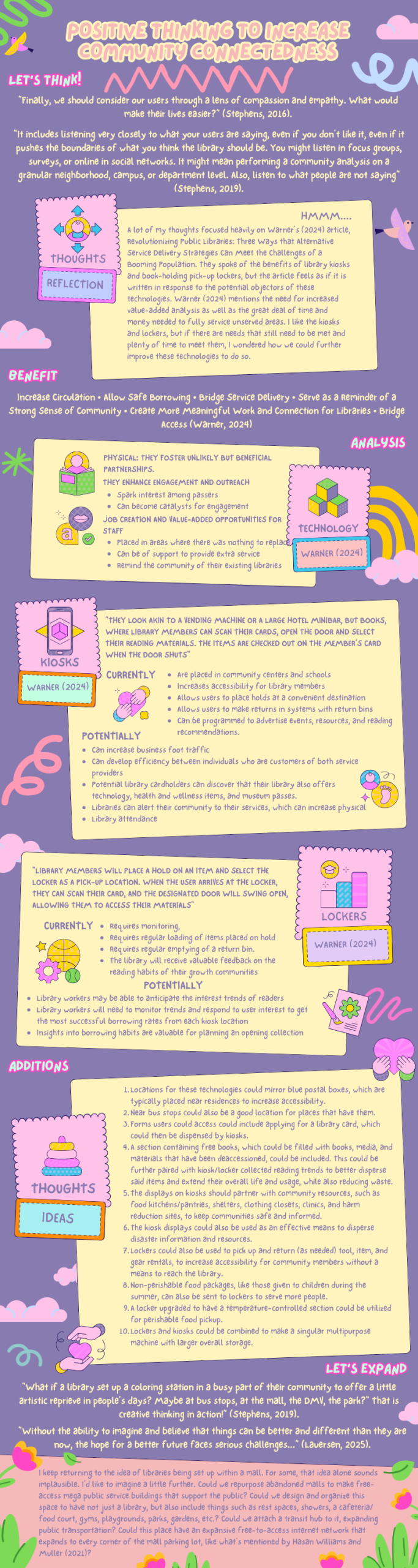
A lot of the readings in module 5, Hyperlinked Communities, gave some really great examples of the different ways libraries and library workers have implemented to better meet and serve the needs of their communities. Each article I read, whether it was about book mobiles (Lauersen, 2025) or after-hour movie nights (Hasan, 2022), kept me thinking up new ways to improve these initiatives. I was really inspired by Warner’s (2024) idea of library-led alternative service delivery strategies, which improve physical, social, and digital infrastructure. Thinking of ways to further meet people’s social, mental, and health needs has been something I’ve been stuck on and excited about since module 1. Referencing my thoughts from my assignment X blog post, I have decided, for this module, to share some of the ideas I thought of while reading.
I leave you with this video.
@cnbc CNBC’s Gabrielle Fonrouge reports on a growing trend of developers converting shopping #malls into #apartment buildings. At The Arcade mall in Providence, Rhode Island, developers came in and built 48 micro units on the second and third floors. Dozens of tenants now live there, and real estate investors have bought other units to rent on Airbnb. Watch the full video at the #linkinbio or tap the link on screen. #CNBC


You May Also Like

Reflection on Hyperlinked Environments: Hyperlinked Museums, Galleries, and Archives

✿ Howdy Y’all ✿