When I first saw the impact compass (developed by the Roskilde Central Library and Seismonaut), my brain immediately thought of the wellness wheel assessment tool. On the surface, they are both radar charts used for assessment and guidance on areas of improvement. I think the association between library impact and wellness is appropriate; some dimensions already overlap between the charts, and we can see how the library can feed into the other dimensions of wellness.
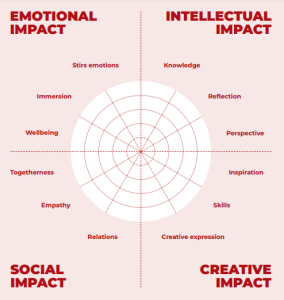
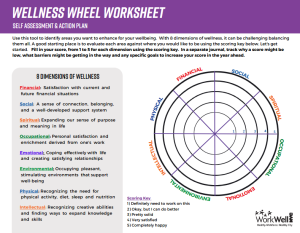
I wouldn’t suggest formally combining the two assessments, but reframing libraries and the work we do as influential and in pursuit of wellness is morale-boosting (in my eyes, at least). The impact compass works as a qualitative tool for libraries, and I can also see it prompting deeper reflection for librarians and library users. While there may always be a bureaucratic imperative for collecting quantitative data, simply reading the 4 dimensions of the compass prompts you to think of your memories and emotions toward the library. I would hope that in my career, the people I help remember any feelings of joy, pride, and connection they experienced at the library, over than simply tracking how many times they’ve visited. We can also tell a more complete and accurate story of the work we accomplish through the lens of our impact.
libraries have become a crucial part of the safety net, the educational system, and the local democracy as well…
However, understanding the library’s impact and the narrative we develop is only one part of advocating for new designs and mindsets about what the library can do. In his interview with CASBS, Klinenberg answered that decisionmakers that fail to see the value of libraries are the reason that some programs and policies to make the library more accessible fail. I agree that there are people that see the library as an outdated institution that revolves just around books, and that it is our responsibility to advocate and change that perspective. However, I also believe there are decisionmakers decreasing access to the library precisely because of its importance to our educations, local democracy, and communities as a whole. Citizens who are educated, engaged with their community, and have access to some basic needs know why and how to fight for a better future. I think recognizing this aspect of our work is also crucial, both as a reminder on why to advocate and to better connect us with the people we serve.
Citations
Gaetani, M. (2018, November 11). Q&A with Eric Klinenberg. Center for Advanced Study in the Behavioral Sciences. https://casbs.stanford.edu/news/qa-eric-klinenberg
Lauersen, C. (2024, August 25). The value of libraries from Roskilde to Toronto. The Library Lab. https://christianlauersen.net/2024/08/25/the-value-of-libraries-from-roskilde-to-toronto/
WorkWell NYC. (n.d.). Wellness Wheel Worksheet. WorkWell NYC. https://www.nyc.gov/assets/olr/downloads/pdf/wellness/wellnesswheelworksheet.pdf