Bonus Episode: Boardgame Librarianship
I wrote this as part of my Metadata class, but I wanted to post it for linking to my Reflection: New Models post.
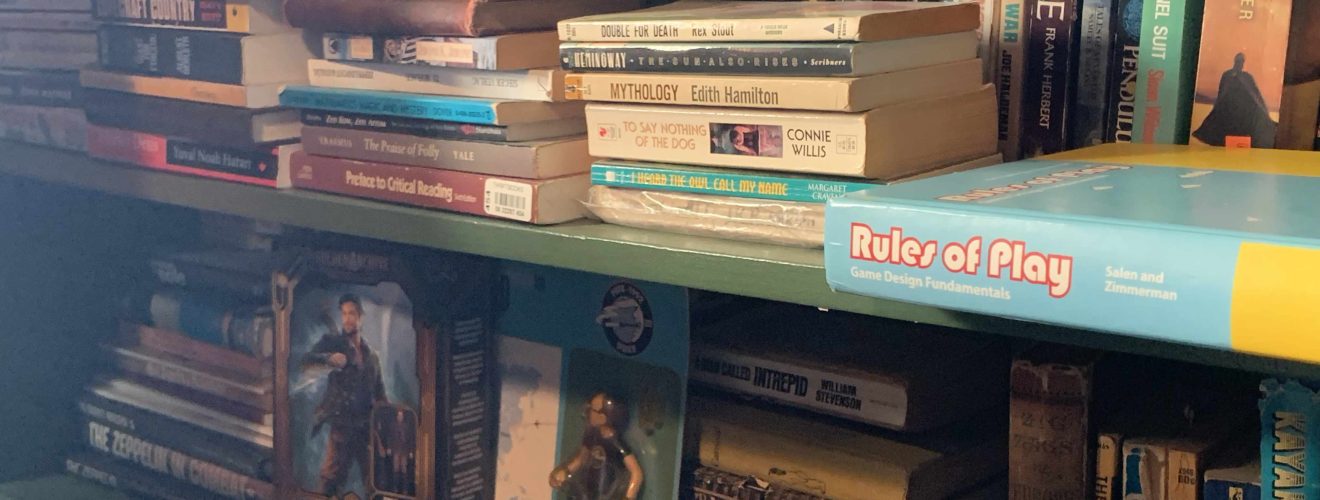
The study of gaming as an activity and the study of games as an artifact has been going on for a long time. My personal library is filled with books that examine, extoll, and research the playing and creation of games. Indeed, making and teaching games was my profession for nearly 30 years prior to me coming to this program. The latest issue of American Libraries features games and game librarianship on its cover. Boardgames are actually quite sophisticated these days, dividing into major taxonomies like “Ameritrash” and “Euro” – each featuring distinctive aspects, signature mechanics, and huge fandoms.
For this assignment I have chosen to use Dublin Core to document boardgames for a theoretical special collection of gaming materials. For the imagined collection, I wanted to use a commonly employed metadata scheme to encourage interoperability with as many library systems as possible. The hope is that the metadata created and provided will enable either inter-institutional sharing or provide a resource to support any library intent on adding these items to their collection. The documented material includes ten (10) actual boardgames. The envisioned environment model and users would be a school or public library with a dedicated section of materials for patrons to peruse, select, and either play in the library or check out to take home for playing with friends and families. I would also suggest the librarian in charge of the collection create a simple reference guide that included a glossary of common gaming terms and a search vocabulary as a finding aid. Websites like boardgamegeek.com are resources that can support creating such a finding aid.
Creating and presenting a successful boardgame program will require a dedicated librarian and subject matter expert who can teach the games or at least answer questions at the time of selection. Like a reference librarian they should be able to explain the resources available to the patron and as a teaching librarian, walk them through the salient points of the games. The key feature is to encourage the experience of play rather than emphasizing “getting it right.” All games need a few play throughs to really understand its possibility space and all players can benefit from understanding that all games offer an arena to encounter and experience things, and aren’t only about the competitive aspect. There are in fact many cooperative and party games that are sophisticated and well worth their inclusion in a game collection.
Metadata Template and Generator
https://nsteffel.github.io/dublin_core_generator/generator.html#format
The Dublin Core generator I used was found online after a search, and I elected to use the “advanced” version to give me a greater number of fields to adapt for the boardgame artifact. The generator offers fields for data entry and an interface to allow repeating the field with new entries. Looking at the generator and the linked guide to Dublin Core elements (https://www.dublincore.org/specifications/dublin-core/usageguide/elements/) allowed me visually think through how I would adapt the existing fields for boardgame description. I used the first item to work out the format and create a template and the reasoning I would follow. The generator then allows selections for the output language and formatting. I elected to output in XML and to use all the options for root element and namespace.
The metadata I selected includes specialized aspects of the game artifact as well as standard cataloging information. For this exercise I neglect some of the more technical and community-based descriptors. I felt that any first-pass at defining field and a controlled vocabulary would include mistakes and omissions. The specialized data refers to aspects of the game artifacts that impact its play. Player count, playing time, and core game mechanic are all aspects of a game that are akin to descriptive terms of a book (e.g. page count, illustrations, index, language) that help a patron understand the item in order to determine if it is for them. All fields are repeatable for clarity, e.g. if there is a second designer or multiple artists, for the number of game mechanics, and the number of languages.
| FIELD | APPLICATION |
| Title | Repeatable. The title of the game, starting with its simplest, or most well-known name and adding any additional elements, subtitles, etc. |
| Creator | Repeatable. The game’s designer(s) or author(s). |
| Subject | The game’s base technical description in concise natural language. |
| Description | A natural language description of the game’s salient points. |
| Publisher | The publishing company that produced the item. |
| Contributor | Repeatable. The game’s credited artist, editor, rule development, etc. |
| Date | The year this item was published. |
| Type | Repeatable. This is a repeatable field that details the game’s played experience in technical and searchable terms. These terms are industry-standard and understood by designers, publishers, and players. |
| Format | Repeatable. This is a repeatable field that describes the game artifact (this item) in practical, real-world terms. |
| Identifier | Repeatable. The publisher’s ISBN number and any additional identifiers provided on the artifact |
| Language | Repeatable. This field describes the languages the game’s rulebook, and possibly components, are printed in. |
| Audience | Age range of the intended audience. |
Conclusion
The benefits of playing high-quality board and card games have been studied extensively, and there are several museums and collections centered on gaming as a domain. See the current issue of American Libraries for several articles on the subject. Boardgames are a perfect example of the “library of things” that can be offered to patrons. Historically the idea was frowned upon due to the wear and tear on the artifact itself. In the face of reduced budgets and constrained resources, it is an issue, but there is also a very active trade in used boardgames and a secondary market of replacement parts. Successful prosecution of a gaming program would require a dedicated librarian and a commitment to really understanding the gaming space and presenting it to the patrons in a very curated manner. Boardgames are not easy to pick up and play by yourself, but incredibly easy to learn in a group or with the aid of an experienced player.
References
Boardgamegeek. (2025a). Agricola. https://boardgamegeek.com/boardgame/31260/agricola
Boardgamegeek. (2025b). Blue Moon City.
https://boardgamegeek.com/boardgame/21882/blue-moon-city
Boardgamegeek. (2025c). Carcasonne. https://boardgamegeek.com/boardgame/822/carcassonne
Boardgamegeek. (2025c). Dominion. https://boardgamegeek.com/boardgame/36218/dominion
Boardgamegeek. (2025d). Posion. https://boardgamegeek.com/boardgame/17025/poison
Boardgamegeek. (2025e). Fiji. https://boardgamegeek.com/boardgame/21704/fiji
Boardgamegeek. (2025f). Firefly.
https://boardgamegeek.com/boardgame/138161/firefly-the-game
Boardgamegeek. (2025g). Lost Cities. https://boardgamegeek.com/boardgame/50/lost-cities
Boardgamegeek. (2025h). Roll for the Galaxy.
https://boardgamegeek.com/boardgame/132531/roll-for-the-galaxy
Boardgamegeek. (2025i). The Settlers of Catan. https://boardgamegeek.com/boardgame/13/catan
Dublin Core. (2025). Using dublin core – elements. https://www.dublincore.org/specifications/dublin-core/usageguide/elements/
Dublincoregenerator.com. (2025). The advanced dublin core generator.
https://nsteffel.github.io/dublin_core_generator/generator.html#type
Smith, C. (2025). Jam forever. American Libraries, November/December 2025. 16-19.


love how you connected your metadata work with board games. The idea of a “library of things” for board games is perfect—I have seen many libraries with board games for teens but I think it is essential to have board games for all ages (aside from Chess/Checkers) .
Thank you, Patricia! I love the hobby, the academic and design side, and the experiences we have when we play games with each other. As a board game designer once said – the biggest barrier to success for games is their rulebook – meaning that learning a board game is a challenge and takes a little bit of effort but is some much easier when done with others. 🙂
Hi George,
Your post on the metadata schemes of board games reminded me of the complex nature of implementing metadata schemes for video games in the library. It is a complicated matter to classify a board game or a video game when there are variations, different language titles, and versions, such as Betrayal at House on the Hill, which has three editions. I am glad you addressed this topic and provided ways to classify the objects in the library.
Happy Holidays,
Miguel
Hi Miguel – you are right! The angle and facets are many! THeme, mode, mechanics, editions, etc.- and I would live to be part of the discussions taking up the exploration of a schema. My cataloging and metadata classes were fascinating. Thanks for taking the time to read the post!
I wasn鈥檛 expecting much, but this turned out great.! Really appreciate the effort you put into this.
Thanks very much, Larry, it’s a great topic.