Monthly Archives: November 2025

The Hyperlinked Era, Chelsea’s Version (Virtual Symposium)

As I look back on my journey through this course, I am surprised by how much my understanding of libraries has transformed. What began as a child, a simple appreciation for books and quiet study spaces, has evolved into a deep recognition of libraries as dynamic ecosystems of learning, empathy, and connection. Each of my blog reflections represents a different strand of this interconnected web. Together, they form a picture of what the modern library truly is: a living, breathing network of people, stories, and possibilities.

Relationships psychology concept abstract illustration with couple human heads silhouettes isolated on white background. Vector eps 10 illustration
Photo from Getty Images. (2023, May 3). Accessed via Unsplash. https://unsplash.com/illustrations/relationships-psychology-concept-abstract-illustration-with-couple-human-heads-silhouettes-isolated-on-white-background-vector-eps-10-illustration-4SIwBlKD8JA

In From Stacks to Stars: Exploring the Library’s Expanding Universe, I began to see libraries not just as repositories, but as responders, or places attuned to the evolving needs of their communities. From libraries lending telescopes to offering social support like diapers or literacy programs, I saw that the library’s power lies in how it serves the community. I really resonated with Casey and Savastinuk’s (2007) vision of Library 2.0, or participatory, ever-changing, and rooted in user voices. This realization marked a shift in my thinking from seeing libraries as static institutions to understanding them as collaborative networks of care.

Later on in The Library Reimagined: A Hyperlinked Environment for Growth and Discovery, I deepened my understanding of Library 2.0 by exploring how design and space shape human experience. Drawing on Skot-Hansen’s (2017) framework, I began to view the library as a constellation of inspirational, learning, meeting, and performative spaces. The example of Memphis’s Cloud901 studio revealed that when libraries blend technology and human connection, they empower people to create culture, not just consume it (Grant, 2021). This insight helped me see that every library space, whether physical or digital, is part of a larger hyperlinked environment, one where creativity and collaboration thrive.

a piece of cardboard with writing on it
Photo from Zaric, M. (2022, June 3). Accessed via Unsplash. https://unsplash.com/photos/a-piece-of-cardboard-with-writing-on-it-9iFxTVTiKag

My post on The Next Chapter of Librarianship: Caring for the Whole Person brought me to another facet of the hyperlinked library, or what it means to serve the whole person. The Salt Lake City Public Library’s integration of social work services reminded me that libraries are often the last truly open, public spaces where everyone belongs (Harkins, 2023). Through this example, I began to understand librarianship as both humanistic and hyperlinked, a practice grounded in empathy, equity, and connection. My personal experiences, from being a student who found refuge in the library to now leading storytime, have affirmed this vision. Libraries have always been my home, but now I see them as homes for humankind.

People admire a large globe in a grand library
Photo from Hunko, A. (2025, August 20). Accessed via Unsplash. https://unsplash.com/photos/people-admire-a-large-globe-in-a-grand-library-B69I5gPsias

I then found Magic in Every Story when I reconnected with the emotional heart of librarianship: storytelling. Stories are how we make meaning of the world, and libraries are the vessels that carry them. Through concepts like Bishop’s (1990) “mirrors and windows” and the Human Library model (Wentz, 2013), I saw that storytelling is an act of empathy and empowerment. Libraries today don’t just keep stories, they make and share them. This understanding reminded me that every user, every voice, and every narrative has a place in the library’s ongoing story.

Finally, in The Library of Everything: Exploring Infinite Learning in Modern Spaces, I explored how libraries are becoming platforms for lifelong learning and creativity. Whether through makerspaces, flipped learning models, or self-directed discovery, libraries embody Stephens’ (2014) concept of infinite learning, spaces where curiosity never ends. My childhood memory of learning piano from a borrowed book symbolizes this perfectly, since the library is an open invitation to learn, explore, and grow without boundaries.

group of readers with books in hands characters vector illustration design
Photo from Getty Images. (2023, April 23). Accessed via Unsplash. https://unsplash.com/illustrations/group-of-readers-with-books-in-hands-characters-vector-illustration-design-ERW1nBerH-w

Across all these reflections, a clear theme emerges in that the library is no longer just a place, but it is a relationship. It is where empathy meets innovation, where stories meet technology, and where communities meet possibility. My vision for the future of librarianship is one where libraries continue to evolve as hyperlinked networks of care. As I move forward in my career, I carry with me a commitment to being both a humanistic and a hyperlinked librarian, or one who leads with empathy, listens deeply, and designs services that reflect the diverse lives of the people I serve. Libraries have always been about connection, but now I understand that connection itself is the service.

the word together spelled with scrabble tiles on a wooden surface
Photo from Ling App. (2023, January 12). Accessed via Unsplash. https://unsplash.com/photos/the-word-together-spelled-with-scrabble-tiles-on-a-wooden-surface-qo455fyS_Vw

References

Bishop, R. S. (1990). Mirrors, windows, and sliding glass doors. Perspectives: Choosing and Using Books for the Classroom, 6(3). https://readteachwrite.com/wp-content/uploads/2019/04/mirrors-windows-and-sliding-glass-doors.pdf 

Casey, M. E., & Savastinuk, L. C. (2007). Library 2.0: A guide to participatory library service. Information Today. 

Grant, R. (2021, November). How memphis created the nation’s most innovative public library. Smithsonian Magazine.  https://www.dropbox.com/scl/fi/3g4juvioz86g1m2uj529i/How-Memphis-Created-the-Nation-s-Most-Innovative-Public-Library-Innovation-Smithsonian-Magazine.pdf?rlkey=25yzrxk37civvks7bg6hwaafs&e=1&dl=0 

Harkins, P. (2023, June 20). Salt Lake City downtown library’s new social worker has already helped thousands. The Salt Lake Tribune. https://www.sltrib.com/news/2023/06/20/salt-lake-city-downtown-librarys/ 

Skot-Hansen, D. (2017, August). Library development: From collection to connection. University of Copenhagen. 

Stephens, M. (2014, November 26). Y Library? Making the case for the library as space for infinite learning. https://www.dropbox.com/scl/fi/4zt1yliwb2ffzr8euix2p/YLibraryInfiniteLearning.pdf?rlkey=m0v6lkd43ufilkp5aktawhlpr&e=1&dl=0

Stephens, M. (2019). Wholehearted librarianship: Finding hope, inspiration, and balance. ALA Editions.

Wentz, E. (2013, April 26). The human library: Sharing the community with itself. Public Libraries Online. https://publiclibrariesonline.org/2013/04/human_librar/

Western Governors University. (2020, July 21). What is humanistic learning theory in education? https://www.wgu.edu/blog/what-humanistic-learning-theory-education2007.html

Rolling Access: Reimagining Library Services Through a Bookmobile (Inspiration Report)

When the Palm Springs Public Library temporarily relocated for renovation, many residents suddenly found themselves without easy access to the services and spaces they loved. Rather than letting distance become a barrier, this moment sparked innovation. My inspiration report explores how a modern bookmobile could bring the library back into the heart of the community by rolling into the community to deliver books, Wi-Fi, and creative programming right where people are.

Drawing from successful mobile library models across the world, the report envisions a flexible, technology-driven outreach service that embodies the library’s enduring mission of providing “our community with opportunities to discover, enjoy, enrich and connect with ideas and people throughout all stages of life.” (Palm Springs Public Library, n.d.).

Due to its large file size, I have uploaded the report on Google Drive. You can access it by clicking here. Please note: All images included in this presentation are either sourced directly from Canva (no citation included) or from external sources that are properly credited with APA-style citations. In-text citations are provided for all evidence and examples referenced throughout the presentation, with full details listed on the References page. I did not include image citations on the reference page.


Reference for the quote above:

Palm Springs Public Library. (n.d.) About us. https://www.palmspringsca.gov/government/departments/library/about-
us

The Library of Everything: Exploring Infinite Learning in Modern Spaces (Reflection Blog #5)

Libraries today are vibrant, community-centered spaces that foster learning, creativity, and connection. The modern library has become a hub for exploration, where people of all ages can engage with information, technology, and each other in meaningful ways. As the role of libraries continues to expand, so does the responsibility of information professionals to design learning experiences that are inclusive, innovative, and grounded in theory and practice. My own experiences have shown me that libraries are not just places to access knowledge, but places to create it. From teaching myself piano with a borrowed book to witnessing how libraries now support hands-on learning through makerspaces and technology labs, I’ve come to see how these evolving spaces embody what Michael Stephens (2014) calls “infinite learning.”

Of course, much can be said about the kind of learning that naturally comes from reading. I still remember being in middle school, eager to learn how to play the piano. Music lessons were something my family could not afford, but we did have a keyboard and a library card. I went to the library and asked the librarian if they had any piano sheet music. They led me to the section, and I checked out Taylor Swift’s Speak Now Piano Book. I taught myself to play “The Story of Us,” a song I already knew all too well (see what I did there?). I never became a concert pianist, but I did develop a new skill and discovered a hobby I would not have had access to otherwise, all thanks to my library.

Beyond the books, libraries are places where hands-on learning takes place in what Michael Stephens calls “spaces for infinite learning,” where participation and collaboration reign (2014). In his work, Stephens describes libraries evolving into educational hubs that encourage self-directed, lifelong learning through makerspaces, hackathons, and other participatory experiences. Similarly, Bookey (2017) highlights the next generation of libraries as spaces that foster exploration and creativity, noting examples such as Arapahoe Libraries’ gadget checkout program, Kent District Library’s cutting-edge technology lab featuring 3D and robotics tools, and Cleveland Public Library’s video game zone. These examples reflect how libraries are continually adapting to meet their communities’ changing needs by providing opportunities for users to create, experiment, and learn without limits. In these dynamic environments, learning becomes infinite, rooted in curiosity, collaboration, and the freedom to explore new ideas as quickly as technology evolves. 

KDL Lab from Kent District Library. Taken directly from Bookey, J. L. (2017, December 6). 8 awesome ways libraries are making learning fun. Huffpost. https://www.huffpost.com/entry/8-awesome-ways-libraries_b_7157462

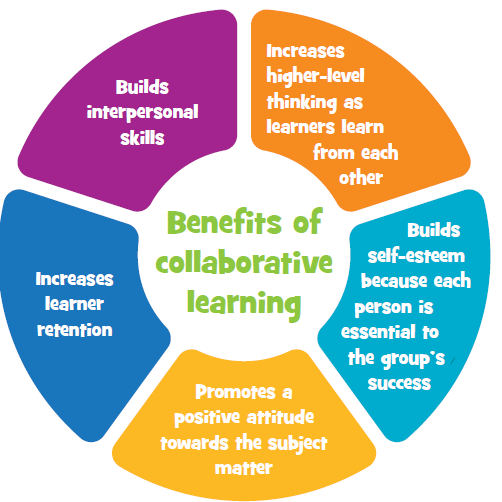
This vision of infinite learning aligns closely with principles of collaborative learning, which emphasize shared responsibility, peer support, and the co-construction of knowledge. Research highlights a wide range of social, psychological, and academic benefits, such as improving communication, reducing anxiety, and promoting deeper understanding through peer engagement (Laal & Ghodsi, 2012). Libraries, through their physical and digital spaces, are uniquely positioned to foster this kind of interaction. Makerspaces, group study rooms, and shared digital platforms allow users to work together to solve problems, explore new technologies, and build community. These approaches not only align with modern educational practices but also reflect the library’s evolving mission as a participatory, inclusive learning environment.

Equally important is the support libraries provide for independent, self-paced learning. This learner-centered approach fosters autonomy, personal responsibility, and lifelong learning, which are core values in library and information science. One strategy that exemplifies this is flipped learning, which allows users to engage with foundational content independently before applying it through discussion or practice. Becker (2021) explains that this model encourages critical thinking and ownership of the learning process, while Snipes and Slone (2015) found that it increases motivation and engagement with complex tasks. Whether through digital literacy programs, online workshops, or self-directed projects, libraries are creating flexible pathways for learning that meet users where they are.

Taken directly from Macmillan Education. (2024, February, 22). Establishing a collaborative learning environment. https://www.macmillaneducation.co.za/news/education-news/establishing-a-collaborative-learning-environment.

In many ways, today’s libraries embody the idea of infinite learning because the hyperlinked library and Library 2.0 is all about adapting to new technologies, ideas, and community needs. They are no longer defined by shelves of books, but by the opportunities they provide for curiosity, experimentation, and growth. Whether someone is checking out a gadget, playing an instrument, or simply finding a quiet place to think, the modern library empowers individuals to learn on their own terms. As Michael Stephens suggests, libraries are “spaces for infinite learning,” and their continued evolution ensures that everyone, regardless of background or resources, has the chance to explore, create, and connect in meaningful ways.

References:

Becker, B. (2021, September 22). The flipped classroom and teach identity. [Youtube video]. https://www.youtube.com/watch?v=o-Fhu4bPV0c

Bookey, J. L. (2017, December 6). 8 awesome ways libraries are making learning fun. Huffpost. https://www.huffpost.com/entry/8-awesome-ways-libraries_b_7157462 

Laal, M., & Ghodsi, S. M. (2012). Benefits of collaborative learning. Procedia – Social and Behavioral Sciences 31, 468-490. https://doi.org/10.1016/j.sbspro.2011.12.091 

Macmillan Education. (2024, February, 22). Establishing a collaborative learning environment. https://www.macmillaneducation.co.za/news/education-news/establishing-a-collaborative-learning-environment.

Snipes, P. R., & Slone, M. B. (2015, April). Successful flipped instruction. School Library Monthly 31(6), 17-20. https://research-ebsco-com.libaccess.sjlibrary.org/linkprocessor/plink?id=db1d8d94-0bd6-3214-be77-159c0ac01cca. 

Stephens, M. (2014, November 26). Y Library? Making the case for the library as space for infinite learning. https://www.dropbox.com/scl/fi/4zt1yliwb2ffzr8euix2p/YLibraryInfiniteLearning.pdf?rlkey=m0v6lkd43ufilkp5aktawhlpr&e=1&dl=0

Finding Magic in Every Story (Reflection Blog #4)

My love for reading started early, long before I understood how deeply books could shape a person. I can still picture myself as a child, standing in front of my local library’s catalog computer, typing in “magic tricks.” To my astonishment, the results revealed an entire section devoted to magic. That discovery felt like unlocking a secret world, and it was the moment I fell in love with reading. Every book since then has left its mark on me, adding small but meaningful layers to who I am today. Now, as an adult, I find myself wanting to share that same wonder with others and to help them see how stories can transform, heal, and connect us.

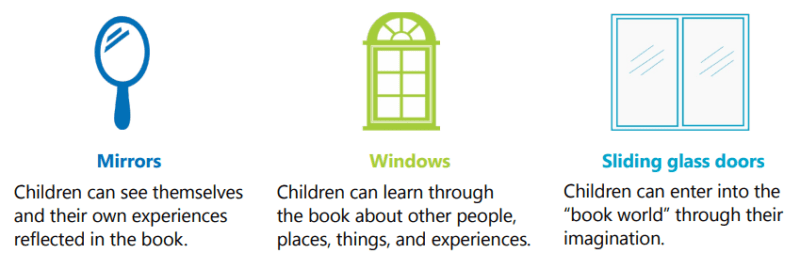
This week’s readings reignited that early sense of awe and reminded me that libraries are more than buildings filled with books; they are living spaces filled with people, each carrying their own untold story. As Dr. Rudine Sims Bishop (1990) famously said, literature serves as both mirrors and windows, with mirrors that reflect our own lives, and windows that reveal experiences beyond our own.

Taken directly from McGree, P. & Pappas, E. (2021, September 2). 24 Positive teacher resources. We Are Teachers. https://www.weareteachers.com/positive-teacher-resources/

When I was young, Junie B. Jones and Ramona Quimby taught me to be bold, outspoken, and unapologetically myself. Later, through the emotional landscapes of Kristin Hannah’s novels, I began to grasp the human cost of war and the resilience born from pain. Her stories were not just entertainment, but they were lessons in empathy and identity, quietly shaping how I saw myself and others.

Taken directly from: Bright, D. (n.d.). June B. Jones. https://www.pinterest.com/pin/414612709422315293/. A direct quotation from Barbara Park’s Junie B Jones.

Libraries have always been guardians of stories, but their role continues to evolve. We are no longer merely stewards of information; instead, we are facilitators of storytelling. Modern libraries empower people to find their voices, to connect through shared narratives, and to recognize themselves as part of a broader human story. The motto of the DOK Library, “Keep stories, make stories, share stories”, (Boekesteijn, n.d.) captures this spirit perfectly. Libraries today are vibrant, participatory spaces where stories come alive through conversation, technology, and creativity. From Human Library events to podcast studios and community archives, libraries are redefining what it means to tell and preserve stories in the digital age.

The Human Library model, as Wentz (2013) describes, is a powerful example of this evolution. Sitting face-to-face with another person and listening openly to their lived experience transforms storytelling into a bridge of empathy. In those moments, the library ceases to be a quiet repository and becomes a living sanctuary for understanding and a place where every story, no matter how ordinary or extraordinary, holds value.

Looking back on my own journey, from the child captivated by a shelf of magic books to the adult who now finds magic in human connection, I see that libraries have always been about transformation, and they give us access to one another. Every shared story has the power to shift how we see ourselves and the world around us.

As library professionals and advocates, it is our responsibility (and privilege) to nurture that magic. Let us continue to build spaces where people feel seen, heard, and valued. When we honor every kind of story, we do more than preserve knowledge, because we strengthen the bonds of community and remind one another of our shared humanity. So, what is your story? What moment, book, or experience shaped who you are today? Leave a comment down below!


References:

Bishop, R. S. (1990). Mirrors, windows, and sliding glass doors. Perspectives: Choosing and Using Books for the Classroom, 6(3). https://readteachwrite.com/wp-content/uploads/2019/04/mirrors-windows-and-sliding-glass-doors.pdf 

Boekesteijn, E. (n.d.). A culture of innovation at DOK and Doklab. https://www.culturehive.co.uk/wp-content/uploads/2020/10/A-culture-of-innovation-at-DOK-and-Doklab-final-2.pdf 

Wentz, E. (2013, April 26). The human library: Sharing the community with itself. Public Libraries Online. https://publiclibrariesonline.org/2013/04/human_librar/