I stumbled upon StoryCorps animations a few years ago and I find them so moving. Regular people, living imperfect lives, trying to get by, and care for others. One of my favorites is called A Good Man. It is the story of brothers Brian and Mike who are estranged from one another when Brian is kicked out of their home by their father because he is gay. It has a brutal beginning, but then leads to something beautiful.
Another one of the animations that really touched me is about one man’s story returning from the Vietnam war, entitled Tom’s War.
I find these animations so heartwarming and through our readings realized that a major reason is because the people are being interviewed by loved ones. I had not realized that part of the tenderness of the videos is the relationship between interviewer and interviewee. I also did not realize that there is a StoryCorp app that does all of the recording and even offers suggested questions. Two ideas that came to mind for me personally was to conduct an interview with my aunt about her trip to the 1964 World’s Fair in New York and with my uncle about his visit to Disneyland on opening day in 1955.
In doing a bit of research about library programs and the power of stories, I came across the ALA Programming Librarians suggestions for how to celebrate the upcoming semiquincentennial of the United States, next year.
They suggest many ideas, such as an essay contest and “Today in History” posts throughout the year. One of their ideas was to have a Memories Road Show with artifacts to display in person and potentially in a database.
I like the idea of using stories and photos as artifacts. We could create an online and in-library display of Great Americans from our community. Library users could submit stories and photos about themselves or loved ones that would highlight their arrival in America, military service, local founders, and people who have done their part. We could provide printed forms with room to attach a photo and to handwrite the details and story of their Great American, as well as having a Survey Monkey type form they could fill out online and attach a photo file.
I believe this could be a simple, but powerful way to keep stories, share stories, and make stories (Boekesteijn).
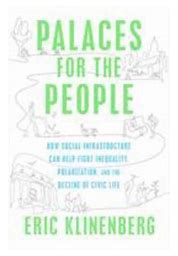
I have interacted with Klinenberg’s ideas in Palaces for the People in several coursesand after this interaction have realized I need to set reading the book as a goal before I finish my MLIS. I would also like to seek out what he has said since. The idea that I find most powerful is that physical places shape the way we interact and are a key element in how we repair fractured societies and a precarious social order (Libraries and the Social Infrastructure). This article made a fresh connection for me when he mentioned that in Sweden, support for libraries diminished amidst a right-wing backlash against new immigrants. Libraries are opposed because they are inclusive places, not just because of the books inside.
This tied in so beautifully with Pam Sandian Smith’s TedTalk about the fresh approach of Anythink libraries. There were three ideas that stood out to me. One, at their library, everything is an experiment. I love the notion that every decision/program/project does not hold our success or define us, we can just try it! Experimenting will have failures or successes, but we’ll learn. Second, was a new quote for me from John Cotton Dana: “The public library is a center of public happiness first, of public education next.” What a delight, that even with the many challenges of librarianship in the current context, public happiness is part of the job description. Finally, “Who else is gonna do this?” American public libraries did not set out to address the needs of immigrants and the unhoused. Neither Franklin, Dewey, or Carnegie had these people in mind, but who else will support the disadvantaged for the benefit of the community.
Finally, Get To Know Your Neighbor blew my mind with its simplicity. A sofa, and a fishbowl of questions is all it takes to build connections. I think this idea could only be improved if it offered a hot cup of coffee as well.
Capitalizing on the popularity of Amy Poehler’s Good Hang podcast, the Murrieta Public Library will host a monthly in-person book club that centers on light-hearted, comedy books, such as those written by the guests of the Good Hang podcast (Ten Steps for Planning, Lecture Module 7).Good Hang has rocketed to the top of the charts in just a few months (currently ranked 7th and 13th for listeners on Spotify and Apple). Amy invites friends and celebrities to share stories and to talk about what is making them laugh. The podcast is not about giving advice, but rather to have a good time. Good Hang
A key component of the book club will be a Facebook page for members that will allow for online discussion between group meetings, building excitement for the in-person meetings, and deepening connections between members. We are seeking to help the Adults in Murrieta to increase social connections and help to address the loneliness epidemic. We will build community through light-hearted fun both in-person and online. The in-person format would follow typical book club discussion questions, while the online community would focus on reacting to clips from the podcast, sharing and responding to favorite passages, and generally being friendly.
Mission & Institutional Context
Consistent with our library’s and city’s goals of being the heart of the community that is engaged, connected, and caring, we aim to fulfill our library’s vision of to improve the quality of life through partnerships, innovation, and meaningful connections. Murrieta Public Library Strategic Plan
VISION STATEMENT
We aim to inspire lifelong learning, creativity, and
curiosity with an understanding of the needs of our
diverse community. We seek to improve the quality of
life through partnerships, innovation, and
meaningful connections.
Based on our SOAR analysis, our community desires more events, with higher attendance, and better external communication. While our SWOTAR analysis suggests that staff desire to be a lighthouse to the community through innovative programming.
With a primary goal of expanding as a community hub, we can work toward our objective of using physical and digital resources to improve access. This would meet further objectives for those who find it challenging to come to the library, such as those who live on the far side of town.
Offering a hybrid book club, would allow people to have the convenience of connection online, while providing a regular in-person community building experience.
Action Brief Statement
Convince Adults in Murrieta that by participating in a Hybrid Comedy book club, they will leverage the accessibility of social media to deepen in-person connections, which will alleviate loneliness by building community, because the Murrieta Public Library has a vision to build meaningful connections.
Inspiration
Since the pandemic, online book clubs have become popular across the country. Typically the book club meets online using Zoom of Google Meet, free applications that many people are comfortable with.
Additionally book clubs are provided through services such as PBC Library Book Clubs | Engage More Patrons | PBC GuruThese book clubs are “professionally moderated” and do not require, but allow for the library to co-moderate the online chat discussion.
We intend to use Facebook as a supplement to our in-person discussions. While Discord is a newer communication tool, 47 percent of our users already use Facebook to connect with the library. Facebook is not the leading edge of technology, it is where we find our largest group of patrons (Adopt or Adapt, Stephens). It is an all-purpose platform that allows for comments, questions. polls, user-generated content, and fosters a sense of familiarity (LIS Education Network)
In mentions using a popular podcast as a tool for Readers Advisory. As we are conducting our 3-month Beta test of our Hybrid book club, this can be a theme to highlight in our collection placing these books in our front display case and highlighting them on our Facebook page. Gifts of this hour, Stephens (2019)
Eighty-one percent of library users have a smart phone (Services to Mobile Users), making Facebook easily accessible for most users.
Facebook interactions will set the foundation for our discussion allowing the in-person meetings to have a warmer, social feeling.
Develop discussion prompts for in-person meetings and companion media (quotes, articles, podcast videos) for the Facebook discussion group. (Running book discussion groups : a how-to-do-it manual by Lauren Zina John)
Order extra copies; ensure e-resources are licensed for simultaneous use.
Plan facilitation structure (moderator rotation, group norms).
Deliverables: Reading list + discussion materials for the first quarter.
Version 1.0.0
Weeks 7–8: Outreach & Registration
Goals: Recruit members and promote the club.
Announce via newsletter, social media (Facebook and Instagram), flyers, and library website. Advertising on Facebook will be a key strategy, as it will capitalize on the most common way users interact with the library on social media.
Outreach will focus on the fun, light-hearted nature of the Good Hang podcast, sharing clips from the podcast to engage users.
Set up online and phone registration.
Offer a short “tech orientation” drop-in session for first-time virtual users.
Deliverables: Active registration form, promotional materials, tech orientation date.
Week 9: Final Prep
Goals: Confirm readiness for public launch.
Send calendar invites, reminders, and tech instructions.
Outcomes: Increased use of library service, new library card holders
Future Expansion
Future expansion ideas could focus on other popular podcasts. Additionally, book clubs centered around YouTube and other short form content creators would be a a great foundation for a Teen hybrid book club that is carried out in-person and online on Discord.
After being away and bringing a fresh perspective to the hyperlinked library in Australia, Dr Stephens noted, “Ten years ago the focus was on using the social side of the web to extend the library, but now our conversations were about being present, meeting people in physical space and virtual, and finding balance.”
Three ways that they are using technology to stay connected are through providing digital tools, focusing on health and wellness, and providing beautiful spaces.
Mua Island, a rocky, well-watered island on the northern coast of Australia had free digital workshops. The workshops brought creative digital tools to the local community through Indigenous Knowledge Center. For many it was their first foray into creative digital tools, expanding opportunities for arts and storytelling.
92% of people in Victoria view the library as a safe place and 72 percent feel better when they go to the library, viewing it as a sanctuary of health and wellness. In Victoria, there is an epidemic of loneliness that is both physically and mentally detrimental. The public libraries of Victoria provide activities that are designed to build social connection and fight loneliness.
Their programs have focused on members of the LGBTQI community, people with mental health issues, and young people.
I was intrigued by their commitment to “co-design-where young people are really telling the libraries what it is that they need from libraries.”
Co-design is a notion that all libraries and communities could benefit from, involving stakeholders in every step from planning to implementation.
In my experience, people are experiencing acute loneliness in my community. While I believe this was inevitable with the shift toward online connection, Covid accelerated the challenge. Our challenge will be leveraging the strengths of technology to build human connection. The PLV use of online book clubs during Covid could be a helpful framework for building connection online that pairs with in-person relationships.