
Module 8, New Models, demonstrates the value of evolving library services as communities’ needs shift as well. These new and emerging frameworks are rooted in connection and explorative learning, transforming the user experience for the better. Among the works I explored in this module, two that I drew connections with my current workplace are HBM Architects’ (2023) Centering Your Library Around the Community and Stephens’ (2019) Hygge State of Mind.
Centering Your Library Around the Community
Libraries must be a reflection of the community they serve, not only in information but also in their structures. HBM Architects (2023) note key considerations when building, renovating, or expanding a library building, including the community’s demographic data (age, race, ethnicity, demographic shifts, etc.), location and context. Furthermore, while main libraries must exist as the municipality/county/state’s primary hub for a wide range of services and programs, branch libraries have opportunities to uniquely reflect one specific community in the system (HBM Architects, 2023, par. 1-2).
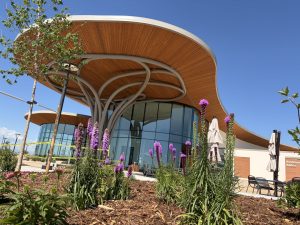
In cases where there are a large number of youth in the community, librarians can consider renovating/adding a space specifically for teens like The Mix at San Francisco Public Library (n.d.), a teen-designed space where their interests are explored in a range of programs, resources, and services. If a library can place greater investment in their structures, they can look to examples like the Anythink Nature Library, a space “shaped with insight from Indigenous and Native American leaders on the Anything Nature Library Advisory Council” that interacts directly with its surroundings (Anythink Libraries, n.d.). This information hub encourages explorative learning, reflection, and discovery with outdoor programming spaces, trail loops, a community garden, and more (Anythink Libraries, n.d.).
During the development process of my library’s art branch, audience, space size, and layout were important considerations. This branch serves the general public, but much of our resources and services are intended for artists and audiences interested in engaging with visual or literary art. Art workshops are typically hands-on and messy, meaning there must be readily available sinks for cleaning hands and materials. Fortunately, there is a sink near the programming space as well as a restroom close by. Considering the variety of programs offered (e.g., reading/working hours, art workshops, writing workshops, exhibitions, film screenings, etc.), the space needed to remain open to change. To accommodate for this, all of the furniture is modular; nearly everything is on wheels or easily portable. The space is small, with only one room for both the collection and programming, but there are large windows which bring in natural light and create an open atmosphere. Furthermore, the space still fits an intimate class size (10-15 patrons), which allows for more one-on-one discussion with artist instructors and other students. The space is excellent for the current needs of the branch and community it serves, and we continue to assess how the space can center the community through surveys and open discussions with patrons.
Hygge State of Mind
Stephens (2019) describes the concept of hygge as a new way of building community with patrons. For many, the term goes beyond coziness, placing focus on “connections, conversations, and comfort” (Stephens, 2019) by fostering a gentle, warm atmosphere. In reading this chapter, I am reminded of mindfulness, a state of awareness of the present moment; the meditation focuses “on your thoughts, feelings, body and surroundings” (Mayo Clinic Staff, 2026). A hygge framework in the library may emphasize togetherness through simple activities in intimate settings.
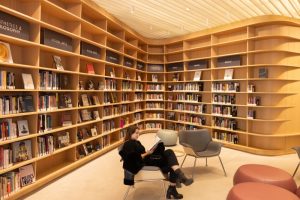
My coworkers and I recently visited the Brooklyn Public Library’s Library for Arts & Culture (LAC) to conduct field research on other specialized public libraries. Some qualities to this space that are reminiscent of hygge, such as the open layout; calm earth tones; and cozy atmosphere. The space does not have any “printers, copy machines or desktop computers… meaning patrons have a peaceful environment to focus on their reading or work” (Brooklyn Public Library, n.d.). This is an intentional decision on their part, ensuring there is no disturbance to the experience of the patrons. There were about 10 or so patrons using the space during our visit, all quietly reading or working. Many of the programs are discussion based, meaning there is a focus on connecting with artists and other patrons.
Some programs held at my library’s art branch invite patrons to a cozy environment that encourages connection and conversation, such as our Comics & Coffee and Junk Journal Club programs. These are monthly drop-ins where patrons work on self-directed projects in a naturally lit, intimate space with light music (and coffee). Everyone is gathered at joint tables and often discuss their art, life experiences, and interests. There is no specific goal or stakes, only creating and community.
References
Anythink Libraries (n.d.). Anythink Nature Library. https://www.anythinklibraries.org/anythink-nature-library/?fbclid=IwAR2DgO-k8nU6kNUODo7vTlRXKiEiYSoSeQMC8Aq0QnoLMZoT3d-QKpbSl5M
Brooklyn Public Library (n.d.). Library for Arts & Culture. https://www.bklynlibrary.org/locations/library-for-arts-and-culture
HBM Architects (2023, February 9). Centering Your Library Around the Community. Library Journal. https://www.libraryjournal.com/story/centering-your-library-around-the-community-lj230207
Mayo Clinic Staff (2026, January 21). Mindfulness exercises. Mayo Clinic. https://www.mayoclinic.org/tests-procedures/meditation/in-depth/mindfulness-exercises/art-20046356
San Francisco Public Library (n.d.). The Mix at SFPL. https://sfpl.org/teens/the-mix
Stephens, M. (2019). Hygge state of mind, in Wholehearted librarianship. American Library Association.