
What are beginner-friendly ways to start telling stories again?
Stephens (2019, p. 83) talks about chaos and caring, asking after the November 2016 presidential election: “So what can we do to help people who visit our libraries who might be feeling scared? The same ways we take care of ourselves can translate into ways we take care of our users.” Clay Shirky introduces the notion of librarians embracing “as much chaos as we can stand” (Stephens, 2016, p. 21). What does it mean for me to embrace as much chaos as I can stand on a personal and on a professional level?

Photo by Ishan @seefromthesky on Unsplash
At my first PowerPoint Party ever, I puzzled over picking a topic. Instead of creating a slideshow from scratch, I chose a pre-existing slidedeck from library school. My hesitance to dive into slideshow creation for the specific event was due to a lack of context on the existing culture of the attendees and what was considered good or funny storytelling in the PowerPoint medium. I hypothesize that for a public library audience, direct prompts encourage the hesitant newcomer to engage confidently with storytelling. For example, I like Dr. Stephen’s idea to tell a story using only emojis. Emojis as a modality of storytelling at the public library seems flexible enough to encourage the participation of drop-in patrons. How does one slowly break the ice of telling stories to their neighbors at the public library?

Photo by Caitlin Erwin on Unsplash
Maybe learning to listen to a story is a part of learning to tell a story. At Timberland Regional Library, WA, Storytime for Grown-Ups reads “a children’s picture book to adults, followed by an excerpt from something written for adults. What are effective ways to convince a individualistic public to listen to stories outside of the mainstream? The internet is saturated with stories. How does one grow in storytelling? What types of storytelling are there?
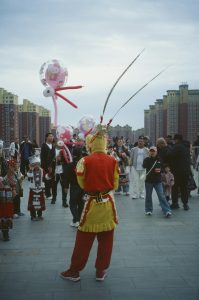
Photo by Quan Jing on Unsplash
Without words, could I tell a story? Have you ever seen a library communication board (Library 2.0, 2020, 10:20)?
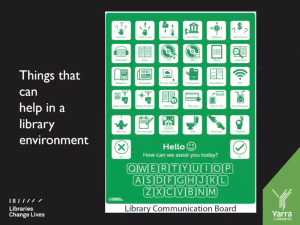
I wondered if any patrons have given feedback on these communiation board tools. Northville District Library, Michigan collaborated with a Speech-Language Pathologist to launch low-tech Augmentative and Alternative Communication (AAC) kits for patron checkout (Trautman, 2026). They are still awaiting public feedback, but I liked how the blog post outlined a roadmap that other public libraries might consider trying out. I enjoyed seeing the different scenarios the Core Boards can be used for, such as going to the library, the doctor, the restaurant, the park, public transporation, or getting a haircut. I could see a library collaborating with a healthcare provider or a public transportation program to gather feedback from the public on these Core Boards.
I saw Chatter and Natter from Storyhouse suggesting the activity of not trying to build a friendship, but sharing simple conversations anywhere from 5 minutes to an hour as a method of combatting loneliness. Storyhouse also hosts Reel Talk Afternoons where attendees can share their thought and feelings after a movie.
Stories come in a variety of shapes and sizes. For the hesitant librarian, I offer the gentle encouragement to pick one that feels appealing to you for some reason, and get curious of getting started in a bite-sized way. For me, this winter, I dream of a bonfire at the library. I dream of a round fire that the public can sit around at the end of a long day. I grew up by the ocean, so I reminisce of a beach bonfire, but bonfires can also happen in forest settings, backyard settings. If the library had a backyard, who would come to roast marshmallows and hear some stories?
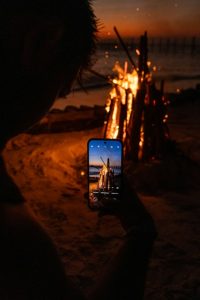
Photo by Nikola Tasic on Unsplash
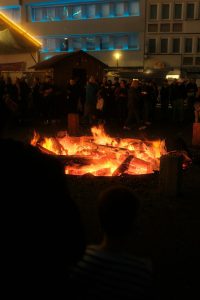
Photo by Arlind Photography on Unsplash
If one giant bonfire is a bit too big, what if there were multiple more intimate sized fire pits for patrons to gather around and listen to a person who has stories to tell?
What about gathering around a hot pot of soup? Soup and stories, everybody listens, everybody eats.

References
Library 2.0. (2020, March 21). The power of stories [Video]. YouTube. https://www.youtube.com/watch?v=dvZlTRTVX10&t=665s
Stephens, M. (2016). The heart of librarianship: Attentive, positive, and purposeful change. ALA Editions.
Stephens, M. (2019). Wholehearted librarianship: Finding hope, inspiration, and balance. ALA Editions.
Trautman, C. (2026, May 13). How We Did It: Library Core Board Kits. https://nwacs.info/resources/materials/how-we-did-library-core-board-kits/
3 responses to “Reflection on The Power of Stories: The Hesitant Public Librarian”
Wow! There are so many inspiring programs and services mentioned in this post!
We have communication boards at the service desk at my library, and while there have been few uses so far, patrons have commented that they appreciate the communication board is there to use.
I love the idea of listening to stories to be inspired to tell stories in different ways, like a Power Point story or a cozy library bonfire story circle. I think this would be extra popular in the winter when it gets dark early. With different types of ambient lighting and cozy seating, there are lots of ways to create a bonfire atmosphere. I think kids and tweens would also enjoy their own space to chat in addition to an adult bonfire. The examples you gave were really simple, but effective settings for providing a space for storytelling. I appreciate this post as a reminder that creating spaces for storytelling do not need to be a large expense or a lot of preparation time. A clever setting and an invitation to use the space is enough to begin connection. Thank you for sharing these lovely ideas.
So cool to hear you keep communication boards at your library. Wondering which library or if they’ve posted blogs or news about it, I’d like to take a gander. I’m hearing you say while there have been few uses so far, patrons still appreciate the inclusive option. I could also see patrons feeling curious or thinking about access in a new way, even if they do not bring it up in conversation. Kids and teens having their own spaces to swap stories remind me of family dinner times when kids get to connect with cousins while adults connect with other adults. At the same time, I see value in intergenerational connection opportunities. Have you heard of: “Kids Meet: Curious kids meet–and interview–people with particular points of view”. https://youtube.com/playlist?list=PL2etPlnTb9sXwY7EgbEdYcfpl4SOeek3_&si=_gxpQ0QEXyS7lrL- The YouTube channel HiHo Kids has 150 videos of Kids Meet.
Our library has not yet posted anything online about the communication board, but that is a good idea! Also, the ‘Kids Meet’ Youtube channel is so good! I watched several of their videos in 2020. I did not realize that there are 150 videos total. That channel is such a good example of the power of stories. The kids have such genuine questions and responses. They are learning about the diversity of human experiences and it is so refreshing to see their interviews through a young person’s questions. Thank you for reminding me of these videos!