
A core concept that stood out to me from the fourth module titled “Participatory Service” in the course INFO 287: The Hyperlinked Library, was that libraries are made for people, not books. The core theme interwoven within librarianship is the significance of community. Libraries offer much more than books on a shelf and must offer more than books on a shelf in order to prevail in our ever changing society. Libraries are places that offer communities a space to grow, learn, and succeed. They intend to service their communities through involvement and support. Shamichael Hallman (author of the book Meet Me at the Library) stated in an interview done through Impact Story that
“A foundational aspect of the library is that it is a home for books, but it’s also a place where people from all walks of life can connect, learn, and belong” (2025, April 10)
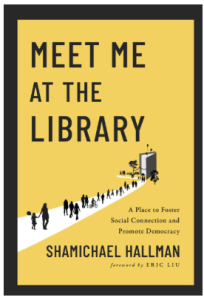
My initial reaction to this concept really opened my eyes beyond the physical space of a library and its general purpose to see that libraries can help support and build communities through services and connection. The idea of connection within a library in a world where connection may be harder to find, makes a library invaluable to our societies. Libraries are created for PEOPLE, not BOOKS. Although books and stories have a way to bring people together, people are the ones who make connections through their ability to share their experiences and learn from stories. Libraries offer a place for people to share their stories in a comfortable and safe environment.
There is an interesting concept since it really reflects the way libraries have changed in their roles over time. The idea that libraries are just places full of dusty books on a shelf has changed over time and with it new ideas have been introduced in our libraries. One interesting and fun new way for libraries to connect their communities even more through people and their stories is called “The Human Library”. According to the article, “From Books to People: The Changing Role of Libraries”, the Human Library otherwise known as “Menneskebiblioteket” in Danish, began over 20 years ago as a social experiment to help foster storytelling and build deeper connections between people by allowing individuals referred to as “human-books” to share their own personal stories and experiences with others at the library (Koley, 2025). This concept emerged from viewing libraries as a place made for people and not just for books. The Human Library is an idea that strives to reflect how knowledge sharing may be more interactive and personal than the more conventional ways of learning. The lecture video created by Dr. Michael Stephens titled The Hyperlinked Library: Participatory Service & Transparency, states the importance to keep stories, share stories, and make stories within libraries (2025). This can help support participation from our communities involved at the liberty, by providing them with a place to do this. It may not always be an easy thing to bring people together from all walks of life, but a library can certainly give people the opportunity to connect and learn from each other. Shamichael Hallman points out this challenge in the interview done through Impact Story and states
“I realized that bringing together people who have rarely shared space requires careful attention. One key insight is that people need to have the skills to belong. It takes empathy and a level of tolerance to be in an authentic relationship with those who are different from you. Listening to their stories helps you understand the experiences and perspectives that shape their lives—and from there, you can begin to uncover meaningful points of connection” (2025, April 10)
Stories help to facilitate meaningful connections and libraries offer the best environment to establish these connections within our communities. I think that the Human Library is a concept that really supports communities through its ability to connect people using stories that come from real life experiences. This really helps to shape my own personal reflection on libraries and how over time ideas like the “Human Library” have guided libraries further into a role where books can be people and stories can be living, breathing, stories taken from real life people sharing their own experiences not found within the pages of a book. I think that more can be done around the idea that libraries are made for people not books, because if the goal in mind is to create something for people, then the outcome will be more community centered and focused. As an emerging information professional beginning very early in my career, I find this idea to be valuable in shaping my future goals. I think that this concept helps to keep an information professional focused on what truly matters, the people. As information professionals, our work is done not for ourselves, but for others. I can see this concept showing up within practice every day because it is a transformative idea that redefines the traditional role of a library into something that enables our information communities to share their own unique backgrounds, knowledge, experiences, and stories by encompassing everyone. I see this showing up in everyday practice because libraries are meant to be inclusive.
References
Koley, S. (2025). From Books to People: The Changing Role of Libraries. Information Research Communications, 2(2), 165–174. https://doi.org/10.5530/irc.2.2.13
Natividad, Ivan (2025, April 10). Impact Story: How libraries can serve as places of belonging. Impact Story. https://belonging.berkeley.edu/impact-story-how-libraries-can-serve-places-belonging
Stephens, Michael (2025). The Hyperlinked Library: Participatory Service & Transparency [Lecture recording]. Panopto. https://sjsu-ischool.hosted.panopto.com/Panopto/Pages/Viewer.aspx?id=2a19a4b6-e945-4d2e-abf1-aef3014172a5