I wanted to put a tin hat on this blog (I have been watching old Doctor Who, sorry) and thought to revisit the Infinite Learning module and professional development experiences. I had two takeaways.
One is that we ought to reflect on that information which we personally have in depth and could be shared with other librarians and information professionals. So, for instance, I know some things about IT, but I am often unsure how much detail people want into how things work. One clue for me is Learning 2.0 participants cited they “better understand IT speak” (Stephens, 2016, p. 135) after training. Perhaps it would be helpful to demystify some of the IT jargon. I wonder what terms are most opaque? Perhaps there are problems with overloaded vocabulary terms where IT and libraries have different ideas about what constitutes a database, for instance? Another clue is that training should focus on “practical implementation of new tools and services” (2016, p. 142).
My other takeaway was the idea to generate a conference report even if nobody asks for one (2019, p. 57). This is part of what the Inspiration Report was for me. I reviewed my notes and presentations from the IDEA Institute on AI in 2024 to prepare the report. The conference was information dense and gave me an overview such that, as above, I could better understand the vocabulary.
The question I am left with now is the same after a conference. How to sustain the momentum? I think ultimately professional learning has to be integrated into daily work. There are times when we need to step back and attend a conference, but I agree we need to cultivate a “culture of learning all year long” (2016, p. 141). Creative outputs, like the Inspiration Report, are also one way to sustain curiosity, provided we are afforded the time. In retrospect, I am grateful to the managers who gave me the opportunity to follow my professional curiosity at work, since I suppose it led me here.
References
Stephens, M. T. (2016). The heart of librarianship: Attentive, positive, and purposeful change. ALA Editions.
Stephens, M. T. (2019). Wholehearted librarianship: Finding hope, inspiration, and balance. ALA Editions.
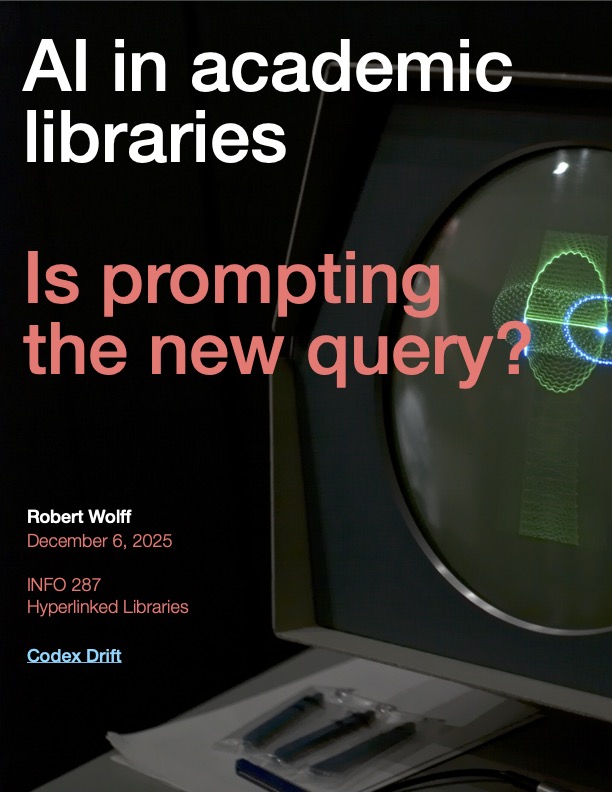
Still from a simple computer animation by David Em for NASA JPL
I struggled at first with how the ideas from these readings related to one another until I realized that communities are mesoscopic. Their unit of abstraction is somewhere in the middle. I think I’m more comfortable at the micro or macroscopic, like a mental model and user interface or else big ideas like information, humanity, or economy.
Everything in the middle is a bit messier, maybe because there isn’t a limit of abstraction to hem it in. It requires both analysis and synthesis. Communities overlap in physical and virtual space; they are continuously changing over time; and people are members of multiple communities simultaneously.
How the library operates at this scale is less immediately clear. Individual user experience (UX) can be assessed and improved, but what does it mean to design for community experience (CX)? Does it make sense to talk in these terms? I think it does, and the readings reinforced that, even if people interact with the library as individuals with unique needs and interests.
Design begins and ends with users and outcomes. This topic nudged me to think about how libraries might address communities’ needs just as we do at user-scale. The first takeaway for me was about community research and outreach. How do we find out more about the communities that use the library most and keep them? How do we reach new constituencies we underserve? And as learn more, how do we foster new forms of community in physical and virtual library spaces?
The answer to these questions are projects like salon-style community conversation, online story-telling platforms, or even just a simple community bulletin board which happens to be mobile (Dixon, 2017). I also appreciated the idea of turning over programming to community groups, if you can get the grant funds to pay them, that is (Smith, 2017). I felt that Ciara Eastell correctly identified austerity as the problem here. This is what lurks behind the constant need to “do more with less.”
Still from a simple computer animation by David Em for NASA JPL
Resource Allocation & Value
No one service or system will meet the needs of every individual. We need to develop an economic model for the allocation of resources for the various modes of user engagement based on the specific user groups’ needs and expectations (Connaway, p. 204).
This was the other big question for me. How do we draft budgets, those mesoscopic counterparts, to allocate resources for the communities we serve? Pewhairangi framed this as focusing on those patrons who generate the most value for the library. But this is backwards, is it not? Generally, we talk about how libraries produce value for communities, not the other way around. This is market logic as applied to libraries, i.e., focus on your core niche of high-value customers. I admit I chafed at this a little. The term “customer intimacy” has a decidedly negative connotation in an era of surveillance capitalism.
But I get the logic. Focus on those who generate most of the usage. Let’s set aside the thorny question of how to quantify this, e.g., how many circulations equal an event attendance or a reference transaction. My concern was it runs headlong into patron privacy. This was articulated by danah boyd (one of my favorites): “Sometimes, it’s not the data that’s disturbing, but how it’s used and by whom” (2016).
People trust the library. Our credibility depends on being responsible stewards of patron and community data. Useful though it is, users must be well informed about the nature of that data collection (particularly if they are already highly surveilled) and accountability must be built in, as boyd suggests.

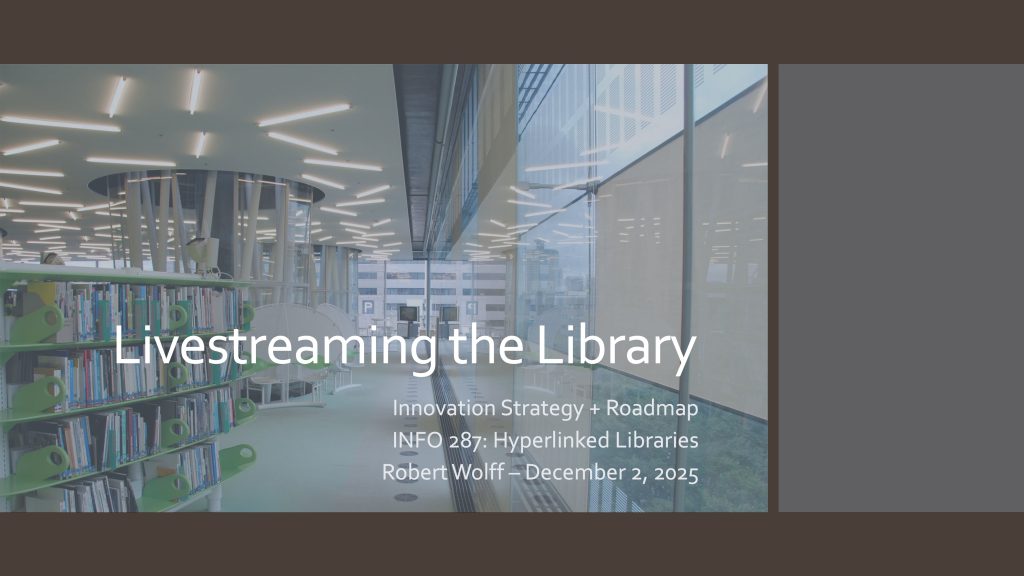 Livestreaming the Library slides
