Hyperlinked Environments in School Libraries
After exploring the Hyperlinked Environments module, two articles that resonated with me the most were the article titled Digital Natives vs Naive Experts by Niamh Ní Bhroin and the article titled 16 Modern Realities Schools (and Parents) Need to Accept. Now. written by Will Richardson.
Bhroin, in her article, explains the findings of a study done among Norwegian children. In the study, they found that while 92% of nine-year-old children in Norway own a mobile phone and have various devices with which to access the internet does not mean that these children have enough common sense to stay safe online. Bhroin describes these digital natives as naive experts because they know how to access the internet via many different devices, but when it comes to uploading videos or pictures of themselves, remembering passwords, or making safe choices when encountering tricky online situations, they still do not know how to make wise choices and protect themselves adequately. Bhroin explains that children need parents, teachers, siblings, and friends who can support them as they encounter challenging situations online (Bhroin, 2019).
Will Richardson explains in his article that parents and school staff need to accept that times are rapidly changing. He explains that a bachelor’s degree for some children is not an option due to their lack of “self-determination” and “disposition”. He explains that what has worked for past generations is no longer adequate, and he calls for a full transformation of how we do things in education to address the needs of our children who are growing up in a very rapidly advancing technological world. He explains that technology is essential in education and that it is changing the way students think and see the world. He calls for a change in curriculum to address the fact that students today have access to technology and information, and this changes the way they learn. Richardson also states that standardized testing is no longer giving adequate results on measuring children’s abilities to “solve problems critically and creatively, deal well with failure, persevere, [and] collaborate with others.” Richardson proposes that for today’s children to be prepared for the future, they must able to connect with others globally to solve problems with computer applications and that this should become the two extra C’s of the 4C’s (creativity, collaboration, critical thinking, and communication) (Richardson, 2016).
I agree with these two articles that children need to be taught digital citizenship and online safety while also incorporating the two new C’s of global connection for problem-solving through computer applications. I also agree that we need to transform education and school libraries because of children’s access to technology and online information. Mathyew Lynch states in his article Saving School Libraries: How Technology and Innovation Help Them Stay Relevant, that school libraries have to change or they will lose their value. His suggestions for transforming libraries include creating spaces much like the Chicago Harold Washington Library’s YouMedia, unbiased and unlimited access to information, creating collaborative and safe spaces for students and teachers, improving digital access of books and information across digital platforms and databases, engaging students in literacy events like hosting authors and reading engagement and challenges, expanding partnerships with local businesses and public libraries, and developing cross curricular learning within the school library walls. Lynch calls for revolutionizing school libraries in order to better prepare students in K-12 public schools and for the future viability of school libraries (Lynch, 2016).
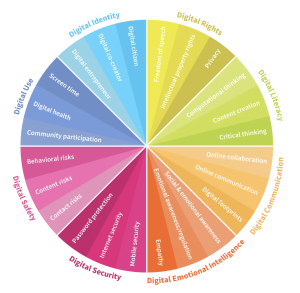
These articles highlight the much-needed work to be done on digital citizenship and online safety to help develop children’s digital intelligence while transforming school library programs. Yuhyun Park states in her article, 8 digital skills we must teach our children, that children need to be taught Digital Identity, Digital Use, Digital Safety, Digital Security, Digital Emotional Intelligence, Digital Communication, Digital Literacy, and Digital Rights. She explains that children need to be taught digital intelligence so they can become the “masters of technology” versus being bested by it (Park, 2016).
This module helped me realize that while I am on the right track in transforming my school libraries by incorporating makerspaces through my STEAM library program, this is only one piece of the school library transformation puzzle. I also need to incorporate a Digital Intelligence program that helps students learn to use technology responsibly and intentionally, so they become informed and empowered digital citizens rather than passive consumers. This will be a significant endeavor, especially with the rapid growth of AI and the increasing amount of time many young children spend using screens, playing video games, and engaging with social media. Even so, I believe this transformation is essential. School libraries must continue to evolve to foster participatory learning, information literacy, and digital intelligence, ensuring they remain relevant and indispensable learning spaces for future generations.
References
Edutopia. (2013, May 7). Henry Jenkins on participatory culture: Big Thinkers [Video]. YouTube. https://youtu.be/1gPm-c1wRsQ?si=pLitU0ncH0X1yCTt
Glick, F. (n.d.). Future ready librarians view innovative libraries first hand in Baltimore County. All4Ed. https://all4ed.org/blog/future-ready-librarians-view-innovative-libraries-first-hand-baltimore-county/
Loertscher, D., & Koechlin, C. (n.d.) Climbing to excellence: Defining characteristics of learning commons. Learning Commons Press. https://sites.google.com/view/liiiitesmodel/home
Hamilton, B.J. (2012, June 28). Makerspaces, participatory learning, and libraries. The Unquiet Librarian. https://theunquietlibrarian.wordpress.com/2012/06/28/makerspaces-participatory-learning-and-libraries/
Learning Liftoff (2024). Nurturing digital literacy in today’s kids: A parent’s guide. Learning Liftoff. https://learningliftoff.com/k-12-education/technology/what-is-digital-literacy/
Mathews, B. (2010, June 21). Unquiet library has high-schoolers geeked. American Libraries. https://americanlibrariesmagazine.org/2010/06/21/unquiet-library-has-high-schoolers-geeked/
Lynch, M. (2016, October 15). Saving school libraries: How technology and innovation help them stay relevant. The Advocate. https://www.theedadvocate.org/saving-school-libraries-technology-innovation-help-stay-relevant/
Ní Bhroin, N. (2019, February 13). Digital natives or naive experts? Exploring how Norwegian children understand the internet. Parenting for a Digital Future. https://blogs.lse.ac.uk/parenting4digitalfuture/2019/02/13/digital-natives-or-naive-experts/
Park, Y. (2016, June 14). 8 digital skills we must teach our children. Medium. https://medium.com/world-economic-forum/8-digital-skills-we-must-teach-our-children-f37853d7221e#.789qtaw64
Richardson, W. (2016, May 14). 16 modern realities schools (and parents) need to accept. Now. Medium. https://medium.com/@willrich45/16-modern-realities-schools-and-parents-need-to-accept-now-64b98710e4e9#.h2ihabdc5

You May Also Like