
As I worked through the material for modules eight and nine in our course content, I kept feeling drawn back toward the Teaching & Learning EDUCAUSE Horizon Report from 2025. Two sections kept gnawing at me: inclusive learning environments and federal policy shifts blocking inclusive innovations. The key takeaway from the EDUCAUSE (2025) report states that inclusive teaching strategies “boost[s] student retention, success, and engagement” (p. 8). I don’t believe that this claim comes as a surprise to anyone in the library world who has worked directly with marginalized patrons.
Then this question loomed in my mind: the facts are apparent and the news is dire, so what can we do about it, especially if we are scared?
I began to dig through peer-reviewed articles published in the last five years tied to the keywords inclusive, academic, and library, and discovered an older framework which I have not read about before: Universal Design for Learning (UDL). UDL is multifaceted and too complex to explore in detail here, but it’s important to note that it was developed based on how a variety of people learn, and at the surface level is a method for producing the most effective, and equitable learning environment (CAST, 2024; Skaggs & McMullin, 2024).
However, a deeper look uncovers significant crossover with inclusionary practices without the terminology that has come under fire in 2025. For example, Shotick (2024) explores how higher education learning environments are systemically white, and how UDL when combined with antiracist pedagogy creates systemic, equitable change in the virtual classroom. The combination of methodologies enables marginalized students to become visible and increases the quality of their education.
It’s not unusual for many people to consider digital materials to be accessible simply because they’re online. White (2024) debated this concept by identifying a study performed on library guides from R1 universities that found 48% of instructional videos did not have accurate captioning, amongst many other accessibility issues. White (2024) goes on to explain in detail how UDL in combination with Web Content Accessibility Guidelines can be used to create accessible and inclusive online environments by acknowledging differences in perception from both physical variance but also cultural and systemic experiences—another DEI crossover.
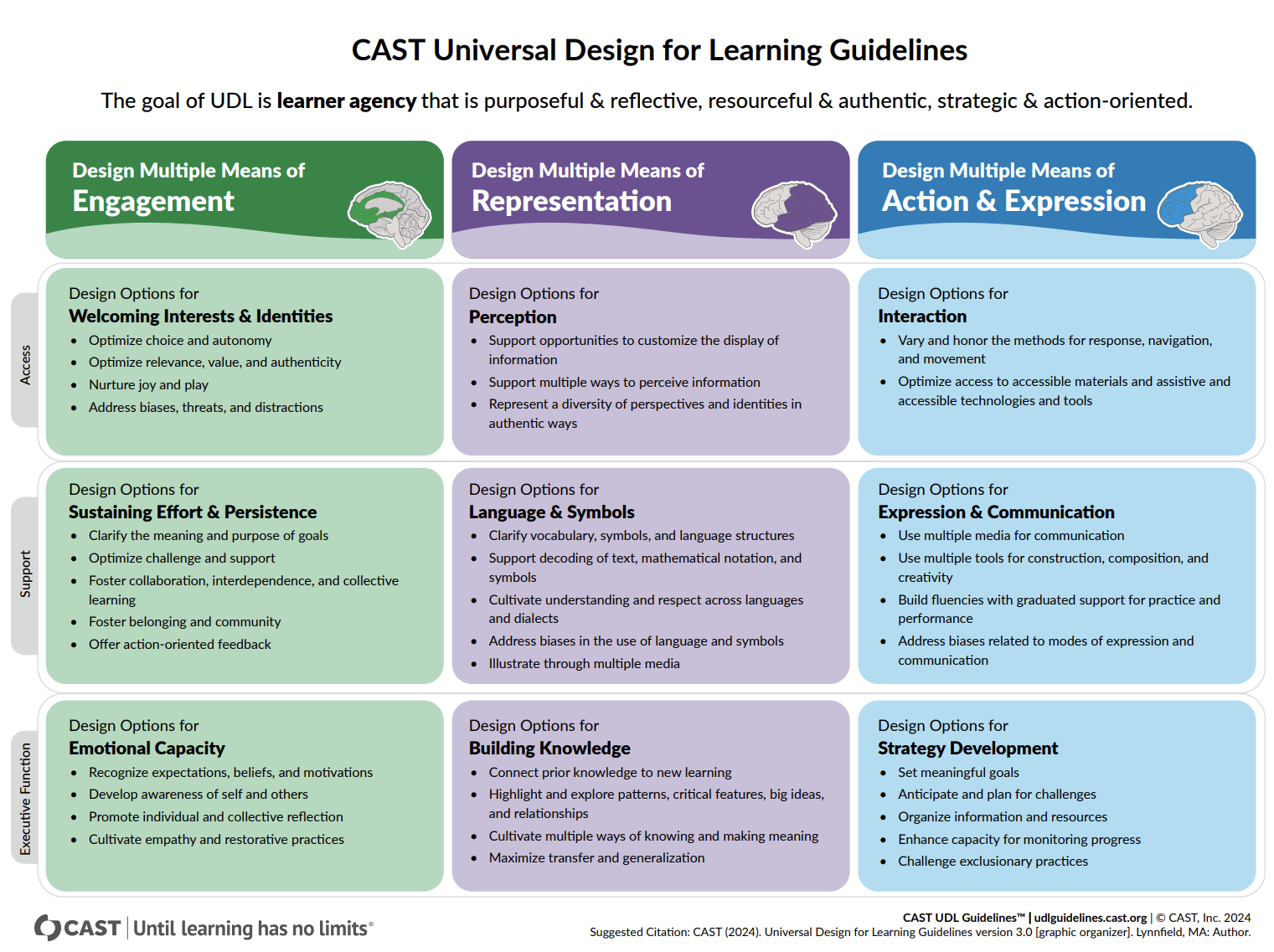
As visible in the graphic above, UDL is complex and has many applications from teaching styles to homework instructions to libguides, and more. While the surface may be focused on learning, there are significant inclusionary concepts that can be found within this framework, and it melds easily with more direct DEI practices. UDL appears to be a functional “band-aid” in a world where federally employed educators and support staff fear retaliation but wholeheartedly wish to continue inclusionary practices to provide the most equitable playing field for evolving minds.
Further Exploration:
- CAST provides many free materials about UDL that include all age groups, and can be applicable in all library settings: https://udlguidelines.cast.org/
- Library workers involved in academia or creating online library guides/materials for adults should explore Universal Design for Learning in Academic Libraries: Theory into Practice. Available to SJSU students here: https://csu-sjsu.primo.exlibrisgroup.com/permalink/01CALS_SJO/tu4ck5/alma991014240891102919
References
CAST. (2024). Universal Design for Learning Guidelines version 3.0. https://udlguidelines.cast.org
Robert, J., Muscanell, N., McCormack, M., Pelletier, K., Arnold, K., Arbino, N., Young, K., & Reeves, J. (2025, May 12). 2025 EDUCAUSE Horizon Report teaching and learning edition. https://library.educause.edu/resources/2025/5/2025-educause-horizon-report-teaching-and-learning-edition
Shotick, K. (2024). Designing for everyone: Accessibility, inclusion, and equity in online instruction. In Skaggs, D., & McMullin, R. M. (Eds.), Universal Design for Learning in academic libraries: Theory into practice (1st ed., pp. 91-108). Association of College and Research Libraries.
Skaggs, D., & McMullin, R. M. (Eds.). (2024). Universal Design for Learning in academic libraries: Theory into practice (First edition.). Association of College and Research Libraries.
White, E. B. (2024). Combining UDL and digital accessibility principles to create inclusive learning experiences in libraries. In Skaggs, D., & McMullin, R. M. (Eds.), Universal Design for Learning in academic libraries: Theory into practice (1st ed., pp. 109-124). Association of College and Research Libraries.
Hi! I love that you came across UDL because it’s so prevalent in the teaching field. I’m a special education teacher and reading specialist, and we use it all the time to make sure we are creating inclusive lesson plans. I had never thought about using it in a non teaching manner. This is awesome!
Thanks for your comment, @bescamilla! I personally am not in the teaching field so these concepts are outside of my knowledge pool. I hope now that you’re seeing it applied in library services that you’ll consider directly bridging your teaching and library knowledge pools more often!
This is great work Katelyn, super-helpful information. I’ve bookmarked your sources and will revisit them as soon as I’ve wrapped up the fall semester. Thank you! Heather
You are so welcome @hharrisbrady! It warms my heart that these resources are helpful to others!
Hi Katelyn,
I found your explanation of the intersection of UDL and DEI issues to be very fascinating, especially given the defunding of various DEI programs and the fear-mongering plaguing our world right now. The fact that you included ways for people to educate themselves beyond this blog post really shows your attention to detail and helps those wondering how to create a more inclusive environment in all your posts.
Great job and thanks for those links,
Miguel
Thanks for your comment, @migueleruiz29. The defunding and elimination of DEI programs is extremely concerning and I felt compelled to write about a “quiet” solution that anyone impacted by these changes might utilize in their workspaces. I’m glad you found the information helpful.
This is a really powerful and timely reflection. I appreciate how the post addresses the tension between Universal Design for Learning (UDL) and institutions that resist DEI efforts it doesn’t sugarcoat the difficulties, but also holds space for creative and inclusive pedagogical solutions. Framing UDL not just as a teaching tool but as a form of resistance feels courageous and hopeful. The post challenges readers to think about accessibility and equity not as add-ons but as essential structural commitments. It’s the kind of writing that reminds educators and administrators: teaching isn’t neutral it’s political, ethical, and deeply human.