Reflection: Infinite Learning
After reviewing the three branches of this module – I notice that playing and exploration are a foundational piece for all learning. I find this rings true to my experience as a life-long learner. I have loved learning new things whether through classes or through serendipity.
The French thinker Roger Caillois described four types of play:
- Agon – competitive play
- Alea – chance-based play, based in games of probability
- Mimicry – role-playing and make-believe play, including theatre and other exercises of the imagination
- Ilinx – playing with the physical sensation of vertigo, as win a child spins until he falls down
And added two (2) qualifiers:
- Paida – wild, free-form, improvisational play
- Ludus – rule-bound, regulated, formalized play
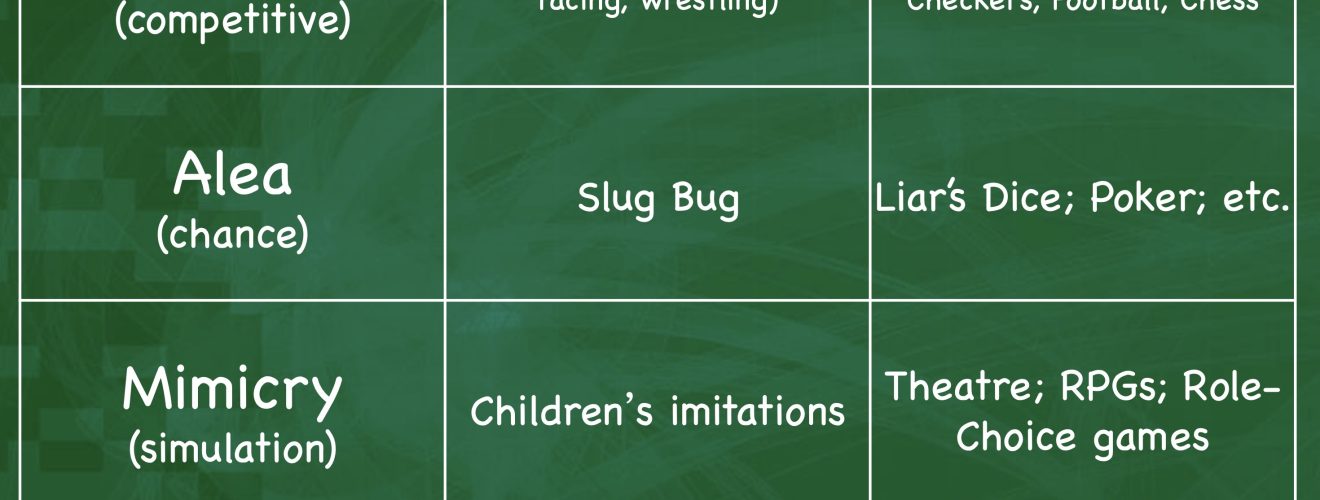
I prepared this chart as part of an introduction to the ideas that underpin game play, but in looking at this chart it becomes easy to map the processes to the state in which we learn.
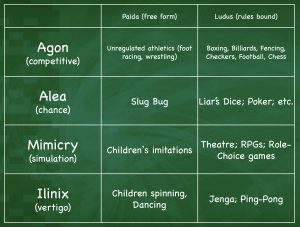
Chart of Caillois types of play
There is another, fascinating aspect to “play” which is the “magic circle”. Described by psychologist Michaael Apter:
“In the play-state you experience a protective frame which stands between you and the “real” world and its problems, creating an enchanted zone in which, in the end, you are confident that no harm can come. Although this frame is psychological, interestingly it often has a perceptible physical representation: the proscenium arch of the theatre, the railings around the park, the boundary line on the cricket pitch, and so on. But such a frame may also be abstract, such as the rules governing the game being played.”
We can see this “magic circle” as also the state in which we enter when we learn – the physical boundaries being the classroom – on indeed the learning space within the library.
With the rise of life skills classes as described in Professor Stephen’s lectures and the popularity of maker spaces, it seems only a short ilinix-inducing hop to a partnership with local music teachers and donated instruments to create music classes. Use your library card to check out a banjo when your parent checks out a tool from the library of things!
On a personal note, in reflection on the Personal Learning Experiences – I have been lucky enough to go to the Game Developers Conference a number of times, and it is a wonderful week-long opportunity to learn from peers in sessions held all day. The greatest challenge (apart from paying for it) is deciding which sessions (classes) to attend.
I recently attended my first librarian mini conference and it was a wonderful experience. There I was able to learn about the challenges that our colleagues are confronting vis a vie chatbots in the library, and I learned a good deal. In Wholehearted Librarianship, Stephens reported that professionals reported needing permission and time (from their leadership) to explore and to learn (p. 56). This resonates with my experience in industry, as well. I would often see an expression of support for the idea of “professional development” but no concrete support in the real world of protected workday hours or financial support to travel to conferences. Stephen’s shows throughout this module, with anecdote and example, how easy, interesting, and exciting it is to create, present, and participate in flipped learning presentations, so I only hope that library leadership is willing to play.